






Skip to content

News

Categories
Andrew Liebhold: vision for the Forest Invasion Synthesis Centre in Prague. From Global Threats to Global Solutions.
Pinned post
29.11.2025

Andrew Liebhold: vision for the Forest Invasion Synthesis Centre in Prague. From Global Threats to Global Solutions.

Lecture
In this talk, Andrew Liebhold presents his vision for the Forest Invasion Synthesis Centre in Prague — a hub designed to bring together scientists from around the world to confront one of the most pressing challenges facing forests today. It sets the stage for FISC’s mission: to advance science that not only diagnoses the problem but also guides real-world action to secure resilient forests.
Kevin Chase: Invasions in Urban Forests
Pinned post
26.11.2025

Kevin Chase: Invasions in Urban Forests

Lecture
Discover how urban areas shape the spread of invasive forest pests and pathogens. Kevin Chase explains why cities become hotspots for new introductions, how live plant imports and propagule pressure drive invasions, and why certain landscapes or stressed trees are more vulnerable. Learn how arborists, researchers, and city managers can strengthen urban tree health and improve resilience across parks, streets, and residential landscapes.
05.01.2026

Looking ahead to 2026

A new year brings new ideas. At Forest Invasion Synthesis Centre, Prague, we enter 2026 continuing our work on forest invasions. We are looking forward to welcoming new colleagues and to preparing a new working group, and to the exchanges and collaborations the year ahead may bring. Follow us and stay connected.
19.12.2025

Magic Spreads Freely. Happy Holidays!

At FISC, we study invasions, pathways and impacts. At Christmas, we allow one exception: magic spreads freely. We would like to sincerely thank all our colleagues, partners, supporters and friends for their trust, collaboration and inspiration throughout the year. Your ideas, commitment and shared curiosity are what make FISC a truly international and collaborative scientific centre. We wish you peaceful and joyful holidays, and a New Year full of good ideas and exciting discoveries.
09.12.2025

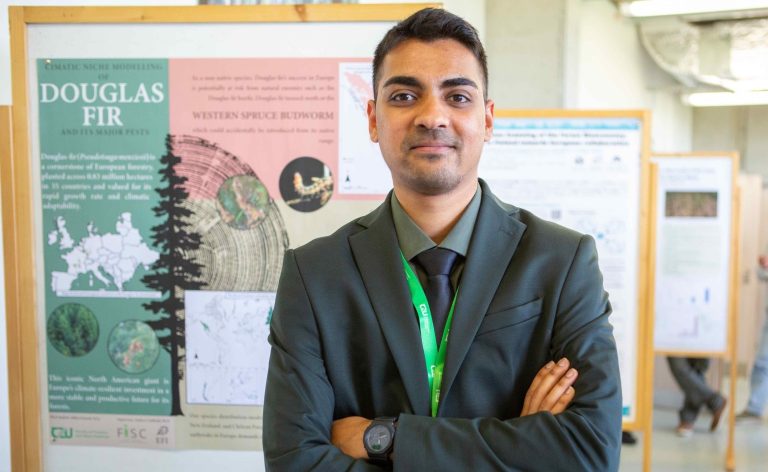
Aditya Ganesh´s talk at European Webinar on Douglas-fir Health now online

Conference
Catch up on Aditya Ganesh’s insights into emerging insect pests of Douglas-fir—his full presentation from the European webinar “Let’s Talk About Planted Forests” is now available to watch. The session, organised by IEFC, IUFRO and EFI, explores current health challenges and biotic risks facing Douglas-fir across Europe.
21.10.2025

In the Spotlight: New Interview with Andrew Liebhold Out Now

FISC in Media
A new interview with our Chief Scientist Andrew Liebhold has just been published. He speaks about his move from the US to Europe and shares his perspective on strengthening research links across continents. Liebhold also highlights how Europe can attract top scientific talent in times of global change.
26.09.2025

FISC Contributes to the Brussels Research & Innovation Conference

Conference
Our scientific leader Dr. Andrew Liebhold shared in Brussels his experiences as a scientist transitioning from the US to Europe and provided an overview of the work at FISC.
26.09.2025

FISC at the EFI Annual Conference 2025

Conference
FISC joined the EFI Annual Conference 2025 hosted by the Faculty of Forestry and Wood Sciences. It was a truly inspiring event and we would like to thank our colleagues at FLD for the excellent organization and the opportunity to share our work!
25.09.2025

Tomáš Hlásny: Forest disturbance monitoring in Europe and recent biotic disturbance trends

Lecture
Discover how Europe’s forests are being reshaped by drought, pests and shifting disturbance regimes, why Central Europe has become an epicenter of change, and how large-scale data and cross-border collaboration reveal both risks and opportunities. Watch the full talk to see how science can guide more resilient forest futures.

Project HIVE 101187384. Funded by the European Union. Views and opinions expressed are however those of the author(s) only and do not necessarily reflect those of the European Union or the European Research Executive Agency. Neither the European Union nor the granting authority can be held responsible for them.