

A new study published in Forest Ecology and Management, led by Aditya Ganesh (FISC) and co-authored by Deepa S. Pureswaran, leader of the FISC working group “Transient impacts of invasive species”, and Andrew M. Liebhold, Chief Scientist of FISC, brings new insights into the risks associated with planting non-native tree species.
Douglas-fir (Pseudotsuga menziesii), one of the most widely planted tree species globally, benefits from what ecologists call “enemy release” – the absence of its natural pests outside its native range. However, this advantage may decline if co-evolved pests are introduced.
The study addresses a key question: Where could these pests not only establish, but actually cause damage?
Unlike most previous studies, the authors distinguish between:
Using data from North America, the team modelled the potential host ranges and pest pest damage of three major Douglas-fir pests:
Their approach combines species distribution modelling with historical outbreak data to better capture real ecological risk.
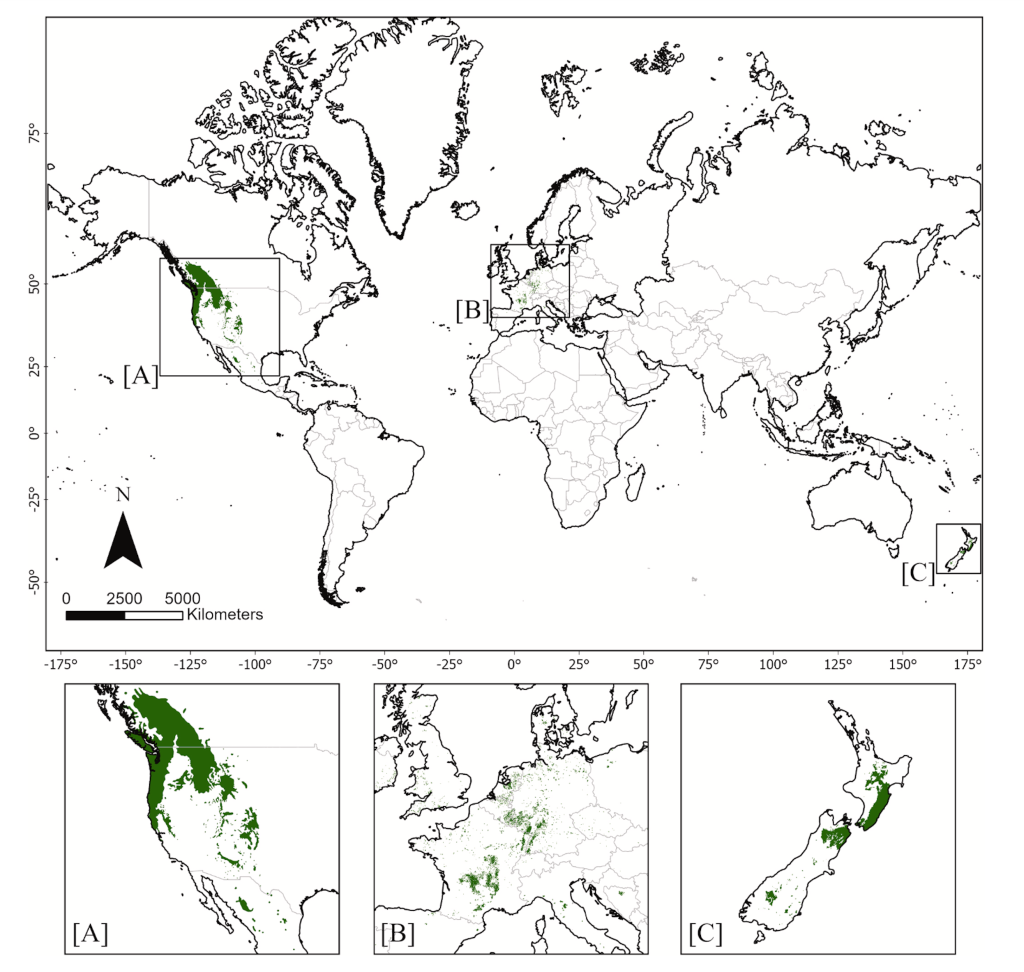
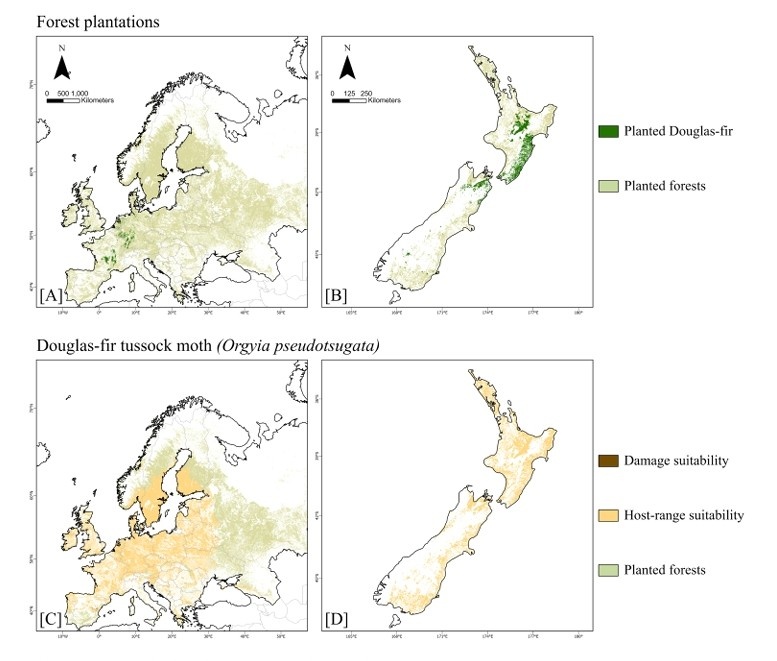
The study confirms that large parts of Europe and New Zealand are climatically suitable for Douglas-fir plantations.
However, the conditions required for pest damage are far more restrictive.
The main result is clear:
Even if these pests were introduced, most Douglas-fir plantations in Europe and New Zealand are unlikely to experience damaging outbreaks under current climate conditions.
This means that while pests could establish over larger areas, outbreaks would be far more constrained.
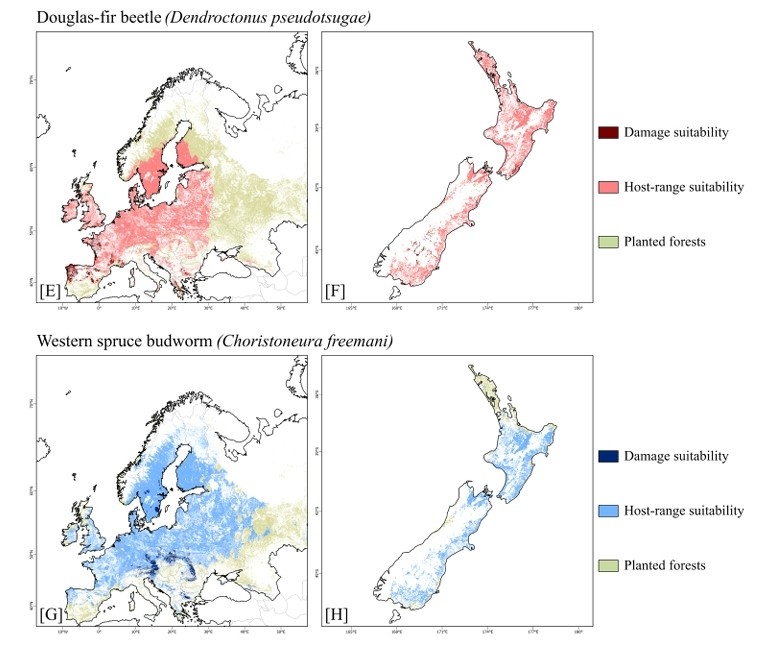
The study highlights an important shift in how invasion risks should be assessed:
This distinction is crucial for:
The findings suggest that non-native plantations are not automatically at high risk, even if pests arrive.
At the same time, the authors stress that:
By separating pest establishment from pest damage, the study provides a more realistic assessment of invasion risks.
For Douglas-fir plantations in Europe and New Zealand, the message is cautiously optimistic:
current conditions do not favour large-scale pest damage.
Read the full article HERE.
Project HIVE 101187384. Funded by the European Union. Views and opinions expressed are however those of the author(s) only and do not necessarily reflect those of the European Union or the European Research Executive Agency. Neither the European Union nor the granting authority can be held responsible for them.