
In their article, the authors focus on bark and ambrosia beetles (Scolytinae and Platypodinae) – a group that includes many economically and ecologically important invasive forest pests. Using a unique, large-scale dataset covering the entire conterminous United States, the team analysed patterns of both native and non-native beetle species richness in relation to tree diversity, native insect diversity, climate and socio-economic factors.
The results provide little support for biotic resistance in this insect system. Instead, higher native tree diversity had little or no effect on invasions by non-native bark and ambrosia beetles. Furthermore, native beetle diversity was generally positively associated with non-native species richness, opposite of what would be expected under the biotic resistance hypothesis. Instead, the strongest predictor of invasion success was the availability of non-native host trees, along with indicators of human activity linked to propagule pressure.
These findings point to fundamental differences between plant and insect invasions. Whereas interspecific competition often constrains plant invasions, it appears to play a much smaller role in shaping invasion patterns of forest insects.
The study contributes to a growing body of evidence suggesting that biodiversity alone cannot be relied upon as a defence against insect invasions and highlights the importance of host availability and human-mediated pathways in shaping future invasion risks.
The study was authored by Jiří Trombik, Soňa Šenfeldová, Samuel F. Ward, Thomas H. Atkinson and Andrew M. Liebhold, bringing together expertise from FISC and international collaborators.
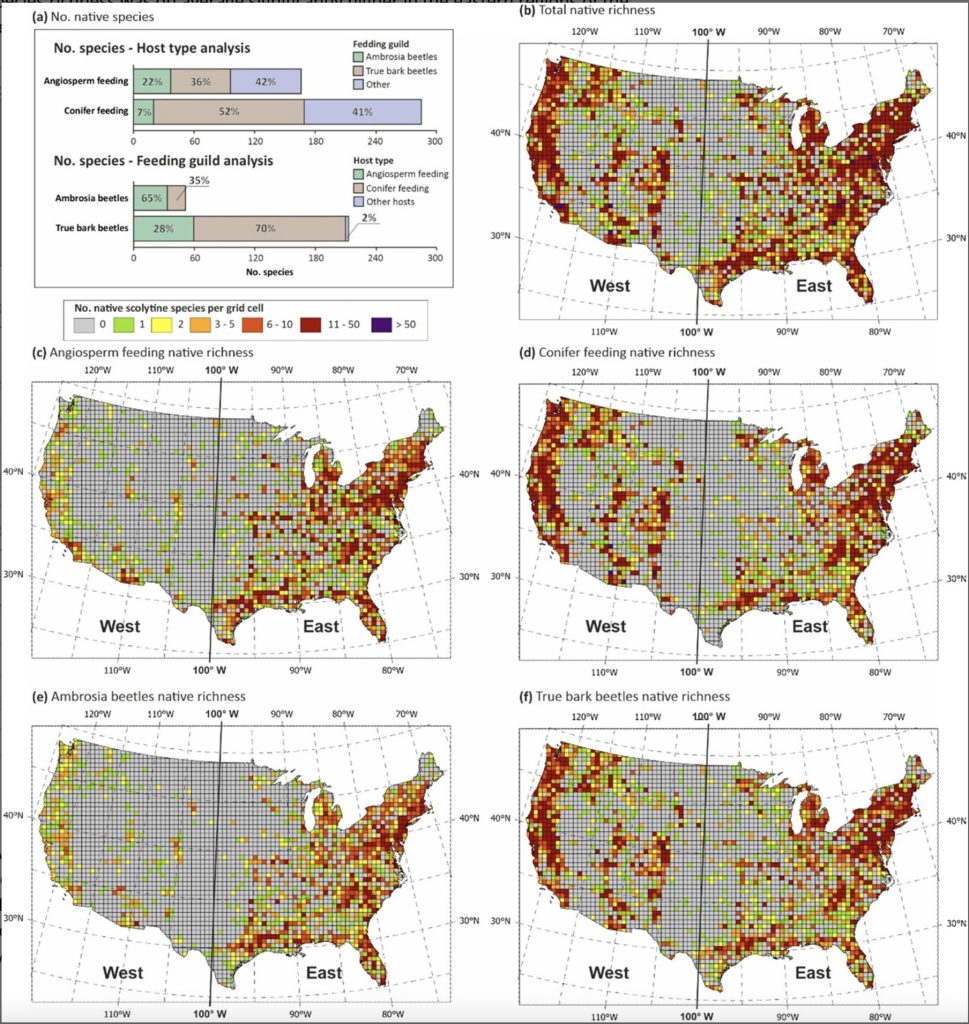
Native Scolytinae/Platypodinae species richness in 50 × 50 km grid cells across the conterminous USA:
(a) richness of species grouped by host type (angiosperm or conifer) or guild (bark beetle or ambrosia beetle); (b) richness of all native species; (c) richness of angiosperm feeding native species; (d) richness of conifer feeding native species; (e) richness of native ambrosia beetles and (f) richness of native true bark beetle species
Source: Trombik et al. (2026), Ecography. Reproduced under the CC BY license. DOI: https://doi.org/10.1002/ecog.08164
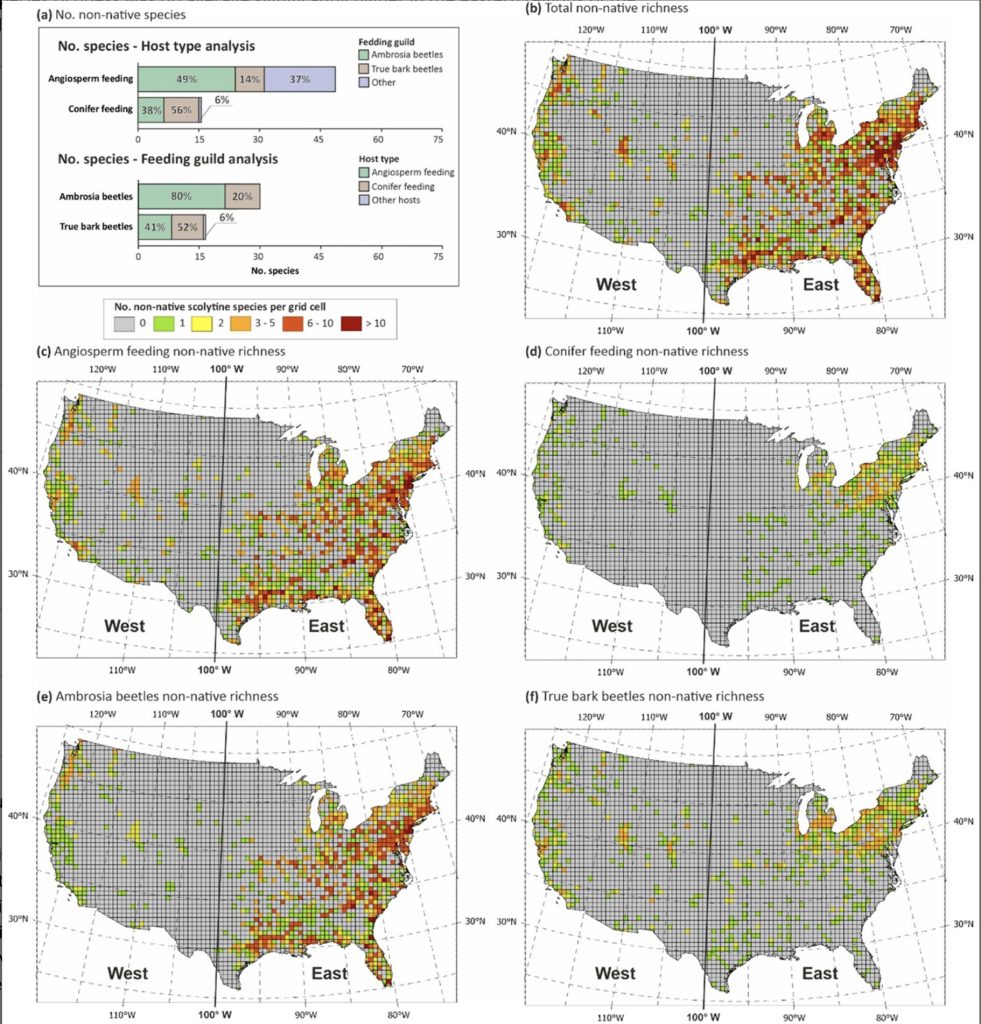
Non-native Scolytinae/Platypodinae species richness in 50 × 50 km grid cells across the conterminous USA:
(a) total richness of species grouped by host type (angiosperm or conifer) or guild (bark beetle or ambrosia beetle); (b) richness of all non-native species; (c) richness of angiosperm feeding non-native species; (d) richness of conifer feeding non-native species; (e) richness of non-native ambrosia beetles and (f) richness of non-native true bark beetle species
Source: Trombik et al. (2026), Ecography. Reproduced under the CC BY license. DOI: https://doi.org/10.1002/ecog.08164
Project HIVE 101187384. Funded by the European Union. Views and opinions expressed are however those of the author(s) only and do not necessarily reflect those of the European Union or the European Research Executive Agency. Neither the European Union nor the granting authority can be held responsible for them.