

Join us for a FISC Talk with Dr. Martín A. Núñez. Biological invasions are reshaping ecosystems, economies, and human wellbeing, yet only a small fraction of introduced species become invasive. In his talk, Martín A. Núñez will use North American conifers, especially pines and Douglas fir, as a model system to explore why some introduced trees spread while others fail.
Drawing on research from Isla Victoria, Argentina, the talk will show how invasion success is shaped by multiple interacting factors. Deer herbivory may favor exotic trees by selectively browsing native species, while seed predation can limit establishment. Propagule pressure, climate matching, and intrinsic species traits provide only partial explanations.
Engage with Dr. Martín A. Núñez and dive into:
the role of herbivory and seed predation in tree invasions
how ectomycorrhizal fungi influence establishment of introduced trees
the role of introduced deer and wild boar in fungal dispersal
why biological invasions should be understood as interaction-driven ecological processes
The talk will take place on Friday, 29 May at 13:00 and will be held in the High-tech Pavilion, room HT0001b, Faculty of Forestry and Wood Sciences, CZU and will be streamed online.
We look forward to welcoming you there!
You can join the livestream via this link: https://teams.microsoft.com/meet/325296076608399?p=i69fLrs7R11nakB6Xs
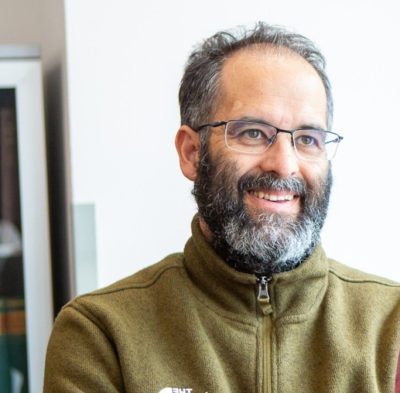
- Ecologist specializing in biological invasions and plant–fungal interactions.
- Professor in the Department of Biology and Biochemistry at the University of Houston.
- His research focuses on invasion ecology, mutualisms in invasion processes, and the global ecology of non-native species.
- Published about 200 scientific articles.
- Serves as Editor-in-Chief of Academia Environmental Sciences and Sustainability and Senior Editor for the Journal of Applied Ecology.
- Leader of the FISC working group “Global patterns of growth of native and non-native trees”.
Project HIVE 101187384. Funded by the European Union. Views and opinions expressed are however those of the author(s) only and do not necessarily reflect those of the European Union or the European Research Executive Agency. Neither the European Union nor the granting authority can be held responsible for them.