

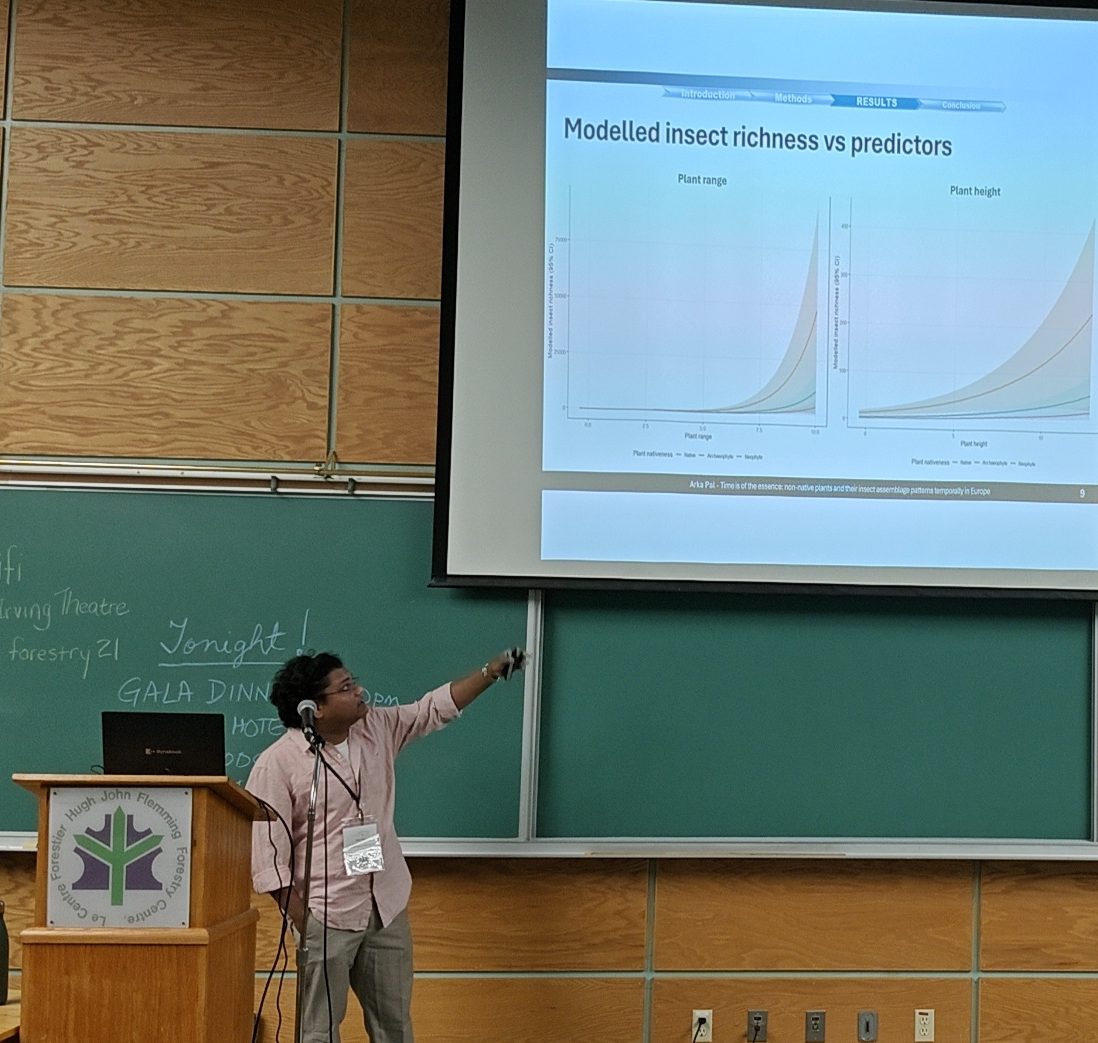
When plants arrive in a new region, they may initially escape many of the insects that feed on them – one of the potential advantages of being a newcomer. But does this “enemy release” last? Research presented by FISC researcher Arka Pal at the IUFRO conference in Fredericton suggests that time matters. For those who couldn’t attend, we’re bringing some of the science beyond the conference.
When a plant species is introduced outside its native range, it often leaves behind many of the herbivores and other natural enemies with which it evolved. This idea, known as the enemy release hypothesis, is one possible explanation for why some non-native plants can establish and spread successfully in their new environments. But enemy release may not be permanent.
As time passes, native insects may begin using the newcomer as a host, while non-native herbivores may also arrive and establish. This raises an important question: does the amount of time a non-native plant has spent in its new range influence the insect community associated with it?
Arka Pal and Andrew M. Liebhold investigated this question at a European scale by comparing native plants with two historically distinct groups of non-native plants: archaeophytes, introduced to Europe before 1500, and neophytes, introduced after 1500.
Archaeophytes vs. neophytes
Archaeophytes are non-native plant species that arrived in Europe before 1500.
Neophytes arrived after 1500, following the beginning of the Columbian Exchange.
This historical division provides a useful way to ask what happens to plant – insect relationships over very long periods of time.
The study used a newly compiled dataset of associations between European plants and herbivorous insects. Rather than simply comparing the number of insects recorded on different plant groups, the analysis also accounted for factors that could influence insect richness independently of a plant’s origin.
These included the plant’s geographical range in Europe, growth form and height, as well as how closely related a non-native plant is to native European species.
This last factor is particularly important. An insect encountering a newly introduced plant may find it easier to shift onto it if the newcomer is closely related to a plant it already uses as a host.
The contrast between recent and ancient introductions was striking.
Neophytes showed a clear pattern of enemy release: they supported significantly fewer native insect herbivore species than native European plants.
Archaeophytes told a very different story. Having been present in Europe for centuries – and in some cases much longer – they supported significantly richer assemblages of herbivorous insects than neophytes. In the analysis, archaeophytes even showed higher richness of both native and non-native herbivorous insects than native plants.
In other words, the ecological advantage associated with escaping natural enemies appears to change with time.
The results also showed that phylogenetic distance matters. Non-native plants that are more distantly related to European native flora tended to support fewer herbivorous insect species.
The findings suggest that enemy release should not be viewed as a fixed characteristic of a non-native species.
A newly introduced plant may initially encounter relatively few herbivores capable of using it. Over longer periods, however, native insects can expand their host ranges and additional non-native insects can become associated with the plant. The insect community surrounding a non-native species can therefore change substantially as its residence time increases.
This also means that two alien plant species living in the same region today may interact with the surrounding insect community very differently simply because one arrived centuries before the other.
The study examined insect species richness rather than the amount of damage caused to plants, so a richer insect community does not automatically mean greater ecological impact. But the results highlight residence time as an important dimension when trying to understand how introduced species become integrated into ecological networks.
Recent plant introductions show a clear enemy-release pattern, while non-native plants with a much longer history in Europe have accumulated far richer herbivore communities.
Time since introduction may therefore fundamentally reshape interactions between non-native plants and insects.
Arka Pal presented the research, Time is of the essence: non-native plants and their insect assemblage patterns temporally in Europe, at the IUFRO conference Ecology and Management of Biotic Disturbances in Forests, held in Fredericton, Canada, from 27–31 July 2026.
Project HIVE 101187384. Funded by the European Union. Views and opinions expressed are however those of the author(s) only and do not necessarily reflect those of the European Union or the European Research Executive Agency. Neither the European Union nor the granting authority can be held responsible for them.