
At high population densities, the emerald ash borer (Agrilus planipennis) can kill infested trees within a year. How might its invasion unfold in Europe, where many ash trees are already weakened by ash dieback? Entomologist Roman Modlinger of the Czech University of Life Sciences Prague shares observations from a visit to infested ash stands in Slovakia. He discusses why eradication attempts have failed, the limits of current monitoring, and approaches to early detection that still need testing.
What did you see in Slovakia, and what struck you most?
The beetle was detected in July. But when I went into the forest stands with Dr Juraj Galko, head of Slovakia’s forest protection service and an expert in forest entomology, the emerald ash borer was present in practically every ash stand. Some infested trees were completely covered with older larval galleries. So it was clear that it had not just arrived: it had been there for at least two years.
Incidentally, I am very grateful to my colleagues at the Slovak Forest Protection Service, especially Juraj Galko, for the time we spent together surveying in the field, discussing what we saw and sharing experience. It was extremely valuable to me.
Is it likely that the beetle is already here and we simply do not know it yet?
I do not think it is here yet.
What makes you say that?
I saw that it was concentrated near the Hungarian and Ukrainian borders. There were really large numbers of beetles there. According to the distribution map produced by colleagues from the Slovak Forest Protection Service, it had been found in roughly half of the Trebišov district and in the district to its north. Trebišov town has a beautiful park belonging to the Andrássy family, with old ash trees of North American species that are susceptible to infestation. Of course, everyone is afraid they will find the emerald ash borer there. Fortunately, they have not found it so far. As I walked around looking for symptoms, I kept thinking: I do not want to be the person who finds this beetle in such a beautiful park! Fortunately, I did not find it either. The reason I mention this is that, even in the east, there seems to be a boundary the beetle has not crossed yet.

Roman Modlinger studies the ecology of bark beetles and their effects on forest ecosystems. His research combines field entomology with modern remote-sensing methods and advanced monitoring technologies to enable earlier detection of the presence and spread of forest pests.
How does the emerald ash borer spread?
It is a strong flier. It can fly for kilometres.
How many kilometres? Can you be more specific?
That is difficult to estimate. Jewel beetles are generally good fliers. For comparison, the European spruce bark beetle has an effective flight range of about half a kilometre to one and a half kilometres, yet with the help of the wind it can even cross the English Channel. I would estimate the emerald ash borer’s effective flight range at around three kilometres. In North America, it spread by about 20 kilometres a year, and the longest recorded jump was about 70 kilometres. That is natural spread. But I do not think the emerald ash borer reached Slovakia by natural means.
Why do you think that?
Between the established infestation sites in Ukraine and the places where the beetle was found in Slovakia lies a roughly 70-kilometre-wide stretch of the Carpathians, which is difficult to cross naturally. I therefore think human activity helped it along, as it did when the beetle was introduced to North America or Russia. It could, for example, have arrived in packaging material or firewood. There is also a large railway transshipment yard in Čierna nad Tisou, where trains may have stood for extended periods because of the war in Ukraine, so that is one possibility.
It would be interesting to look at transshipment yards in Poland as well. I would not be at all surprised if the emerald ash borer were detected in Poland soon. But already now, it has a virtually open route across the Pannonian Plain, which acts as a natural migration corridor. It could therefore reach Czechia by moving around the Little Carpathians through the Bratislava area, or possibly through Austria.
Can anything stop it?
There is general agreement that eradication, which works for some other invasive species, is ineffective against the emerald ash borer. It disperses very well, and it is difficult to detect early. Jewel beetles often live high in the crowns, where they can breed in dying branches, so we can easily overlook them. By the time we discover an infested tree and remove it along with the surrounding trees , that does not mean we have eliminated the entire emerald ash borer population. By then, it has spread much farther. Experience in North America confirms this.
What happened there?
The beetle was first detected in the Great Lakes region in 2002 (US). Scientists then used dendrochronology to study both infested and still-surviving ash trees and establish retrospectively when individual trees had died. They found that the first trees had died about five years before the beetle was officially detected. I think it would be worth investigating the areas around transshipment yards in Central Europe in a similar way.
Could the emerald ash borer behave differently here than it does in North America?
That is a big question. In North America, its life cycle takes two years, and it usually kills a tree within two to three years. We do not know what will happen here. The crucial difference is that European ash trees are already badly affected by the ash dieback fungus (Hymenoscyphus fraxineus), another invasive species from Asia. I therefore expect that the trees’ response could be more severe and that they might die more quickly.
Are there any other factors?
The resilience of the tree itself is one factor, and the size of the beetle population is another. If the emerald ash borer population is larger, it may be able to kill trees within a single year.
Are some ash trees more resistant? Does the species, age or anything else make a difference?
Some ash trees will probably survive, and those are the ones it would make sense to study genetically. But I suspect there will not be many of them. Something similar has happened with the ash dieback fungus, where more resistant individuals have gradually been selected. Unfortunately, it has been shown that resistance to ash dieback is different from the kind of resistance needed against the emerald ash borer. Asian ash species are naturally resistant to the beetle, whereas North American species have been extremely susceptible. European ash appears to be somewhat less vulnerable than American ashes, but its resistance is still very low. Trees in good condition will have a better chance than ash trees already weakened by ash dieback, for example.
What should foresters do now?
Above all, keep watch. The sooner the emerald ash borer is detected and infested trees are removed, the more we can slow its spread. But there is no effective way to stop it at present.
One question for further research is whether declining ash trees could be used as trap trees, as they are for bark beetles, or whether it is better to remove the most weakened trees early. Those are things we now need to test.
How should monitoring be carried out?
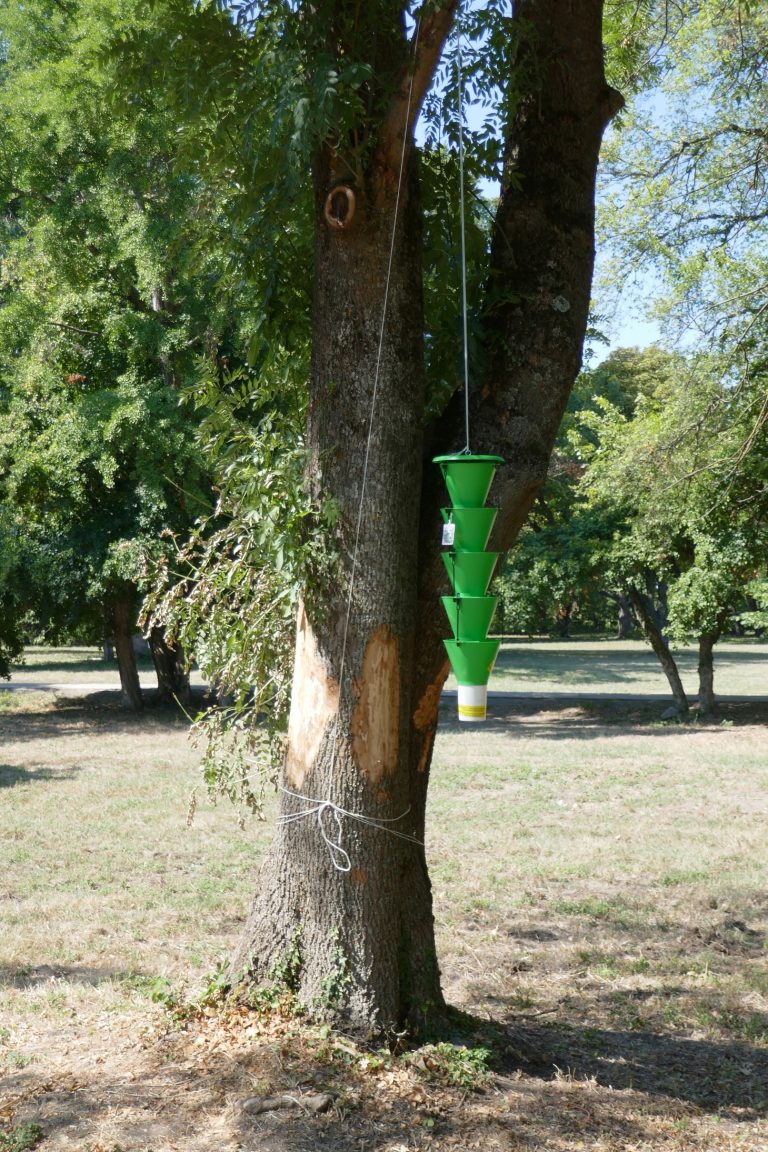
This brings us to another major problem. Current monitoring relies on traps baited with attractants that mimic the scent of ash. The emerald ash borer does not have a pheromone that acts over longer distances. The problem is that the beetle usually only turns up in these traps once the population is already large and may have been in the area for several years. We therefore need to find a more sensitive method of early detection. One approach worth investigating is the use of standing trap trees with girdled trunks, meaning that a ring of bark is deliberately removed around the trunk. Ash trees weakened in this way could be more attractive to the beetle.
Could you explain that in more detail?
It is a method we still need to test under central European conditions. You choose an ash tree and girdle it, which weakens its defences and may make it more attractive to the emerald ash borer. We know from North America that the principle works. The question is how well it will work here, where ash dieback has already weakened many other ash trees. Our experience with bark beetles shows that a trap tree becomes less effective when there are many other weakened trees nearby. That is why we would first like to test the method in Slovakia and, depending on the results, perhaps use it here too. Combining a girdled tree with an attractant may also be possible.
Is it not too late? Research like that will take time…
We could not have started earlier. We knew the risk existed in Slovakia, but no one expected the emerald ash borer to arrive so quickly. Still, I would not see it as a disaster. I do not think it will be detected here as early as next year. I would sooner expect another detection in Poland, for example.
Let us return to the advice for foresters. What should they look for when inspecting trees?
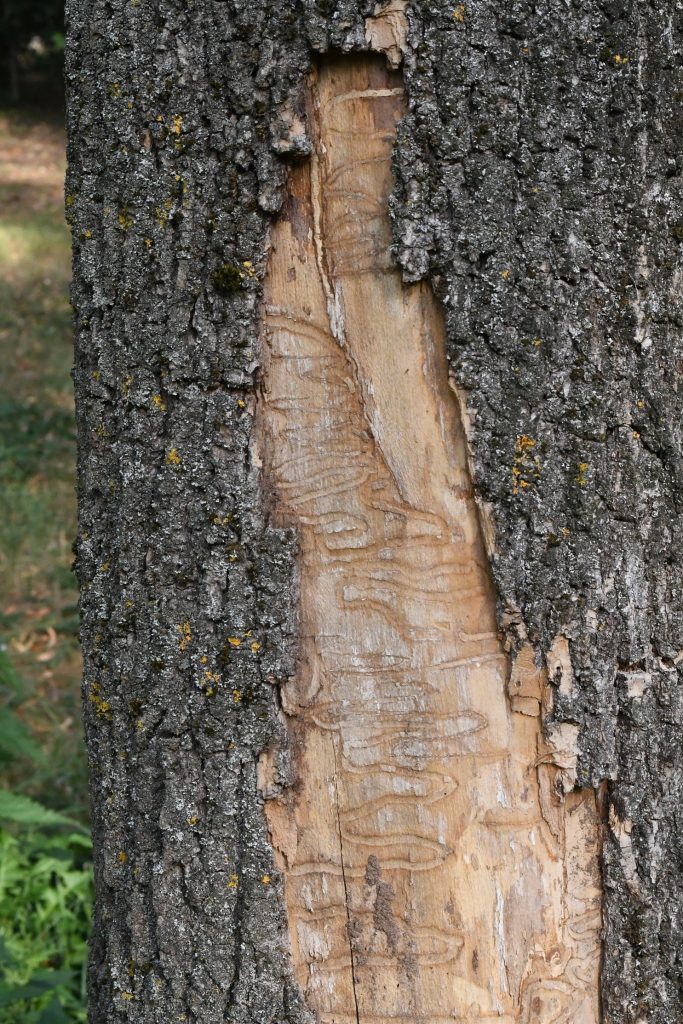
The emerald ash borer’s larval gallery is highly distinctive. We do not have anything like it in Europe. The gallery follows a pronounced S-shaped course vertically, and its successive bends gradually widen. Those regular S-shaped turns are particularly characteristic.
How can you tell where to look for the gallery beneath the bark?
That was probably the most valuable thing I learned during my visit to Slovakia. After a while, I could identify newly infested spots myself from external signs. Birds are an excellent clue because they are very good at finding the larvae.
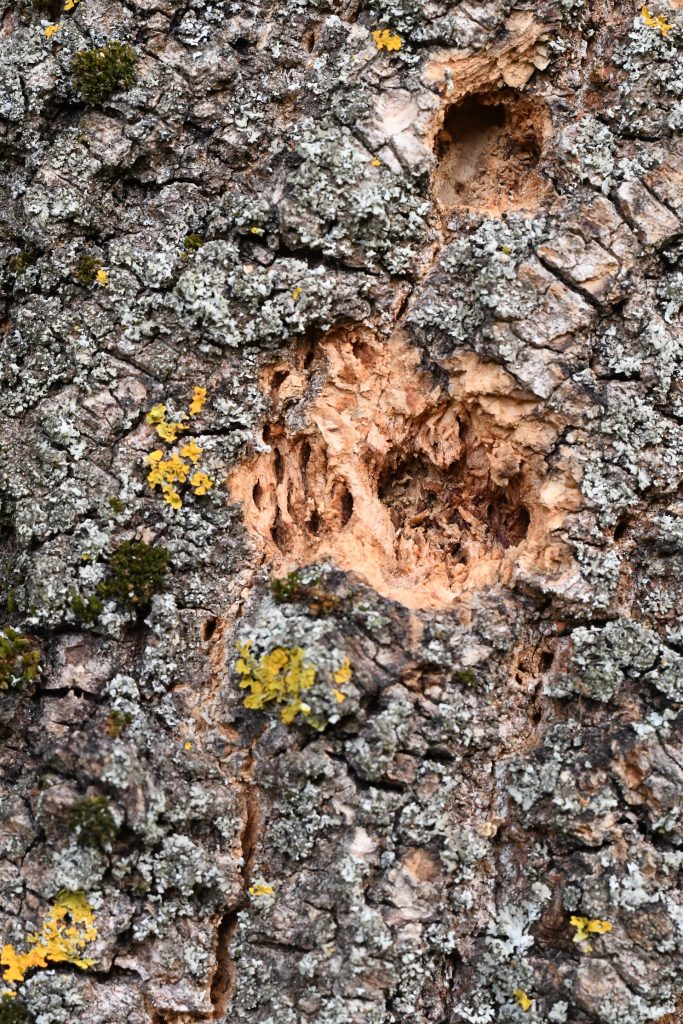
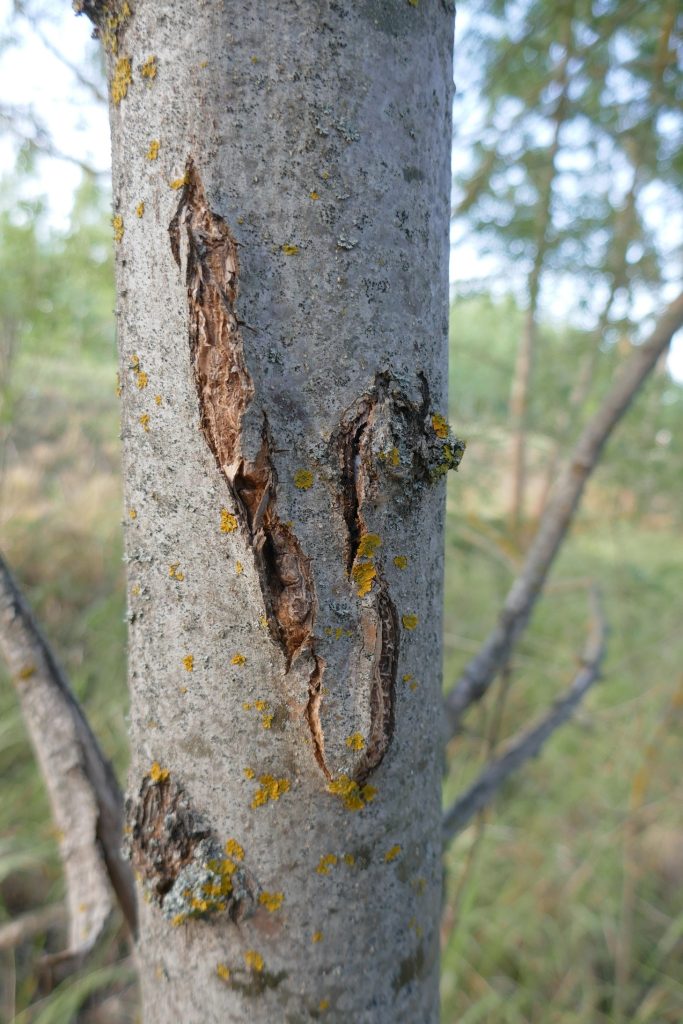
Woodpeckers’ pecks in the bark are a fairly reliable sign of infestation, and the characteristic gallery can be found beneath them. There is another important difference from North America. There, infestations often began in the crowns and therefore went unnoticed for a long time. Here, the upper parts of the crowns are often badly affected by ash dieback and are probably no longer so suitable for the beetle. It may therefore attack the base and middle of the trunk instead, where it is somewhat easier to detect.
From spring onwards, I would therefore recommend inspecting ash trees and looking for individual woodpeckers’ pecks in the bark. If you find them, you need to check whether the cause really is the emerald ash borer, ideally by looking for its characteristic larval gallery, and then contact the plant health authorities or a specialist who can confirm the finding.
What does an emerald ash borer larva look like?
It is a jewel beetle larva, with a narrow head and an enlarged thoracic region, although that enlargement is not as pronounced in the emerald ash borer as in the other jewel larvae. Its body has a sawtooth appearance, and when viewed from the side, the individual segments have a bell-like shape. That is also fairly characteristic of this species.
Are there any other signs that might alert us to the beetle’s presence without removing the bark?
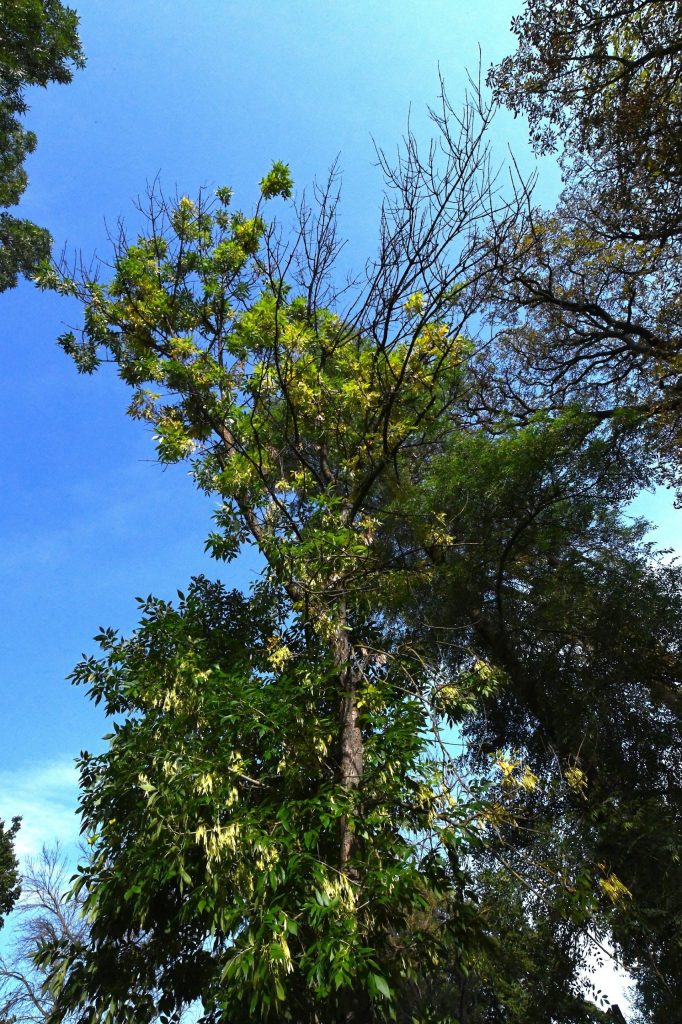
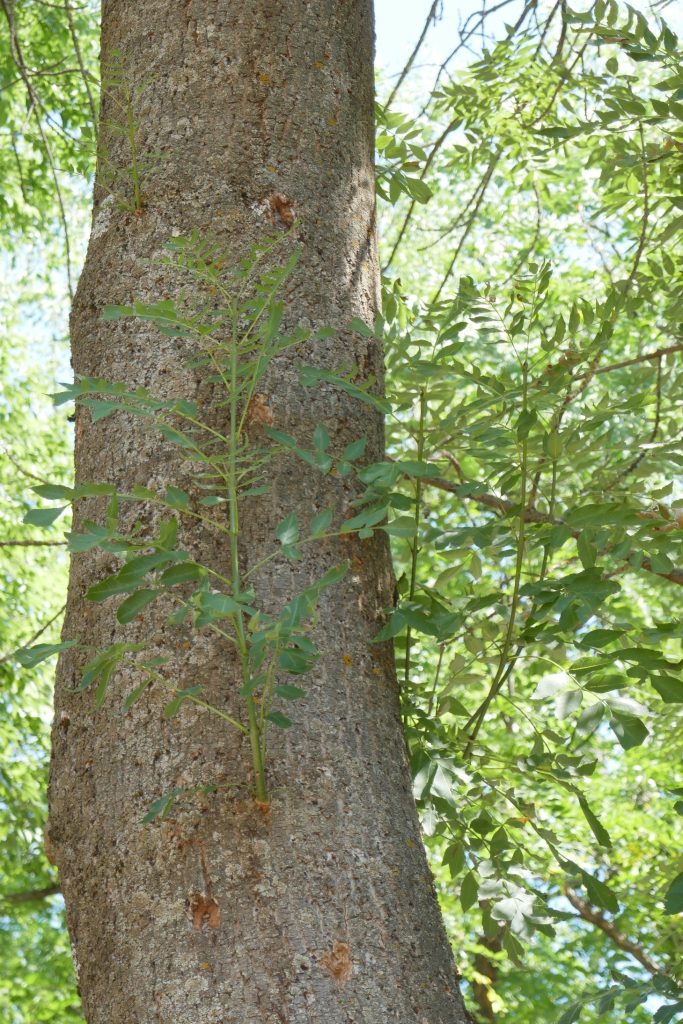
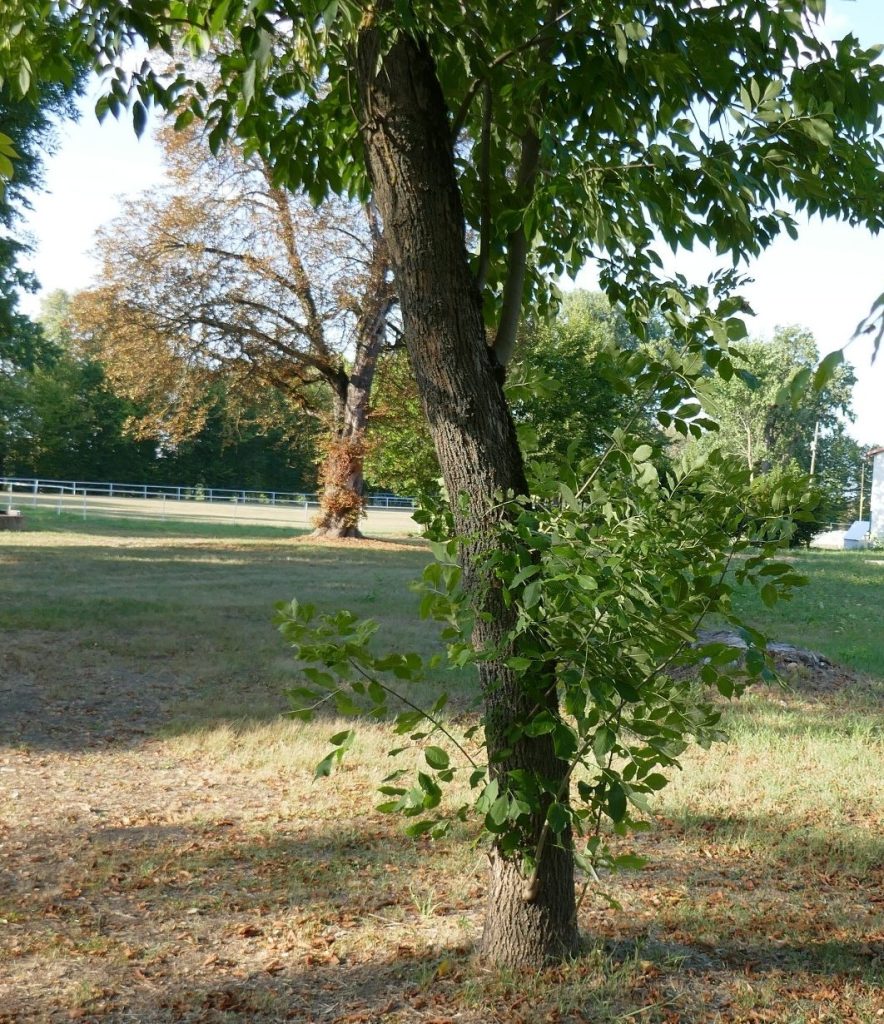
Older trees that have been infested for longer, usually from the second year onwards, may produce epicormic shoots. Green leafy shoots begin to grow from the trunk, often along its entire length. The tree is trying to replace the dying parts of its crown.
Do similar shoots not appear on ash trees affected by ash dieback?
Yes, but usually in different places. With ash dieback, new shoots appear mainly on branches in the crown; from a distance, it can look as though there are clumps of mistletoe in the crown. With the emerald ash borer, epicormic shoots tend to appear directly on the trunk. It is not an entirely clear-cut sign, though, and the symptoms can overlap. So if you see epicormic shoots on the trunk, it is worth examining the tree more closely. Exit holes may then provide confirming evidence.
Is there anything distinctive about the exit holes?
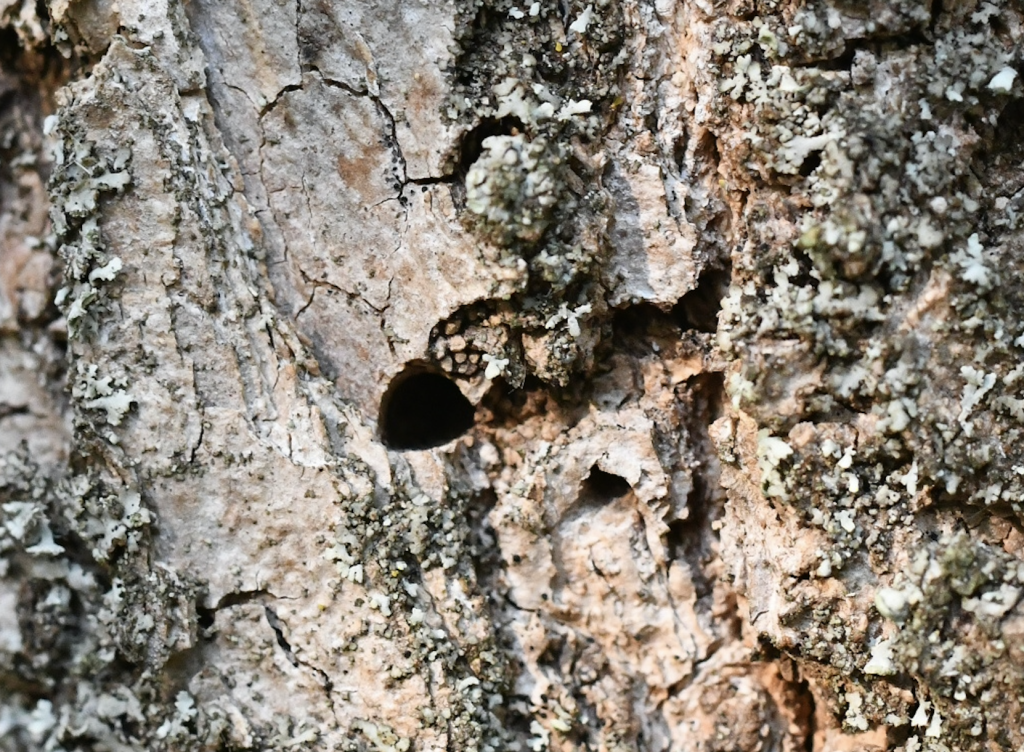
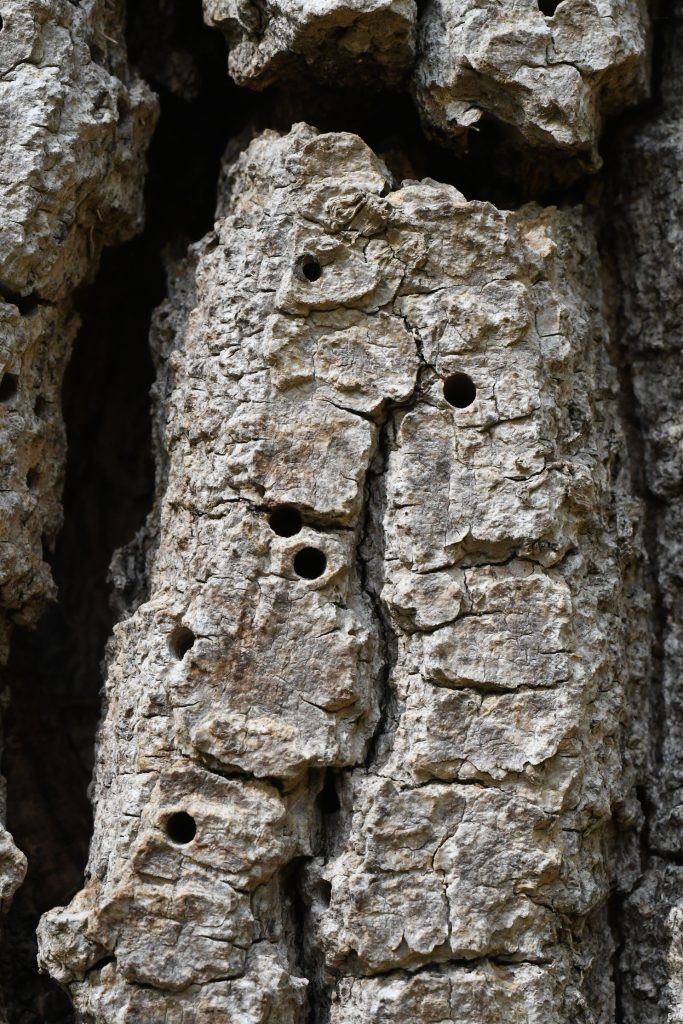
Their D shape is characteristic. It looks quite unmistakable in photographs, but in the field a hole may be slightly oval, and the shape is not always perfectly clear. They tend to be a little larger than bark beetle exit holes. They are also relatively hard to find. Bark beetles often leave many holes on a tree because numerous larvae develop in the same area. Jewel beetle larvae tend to live separately, so D-shaped holes are scattered across the trunk. For an untrained eye, the shape of an individual hole may therefore be difficult to recognise.
Can you think of any other sign of emerald ash borer infestation?
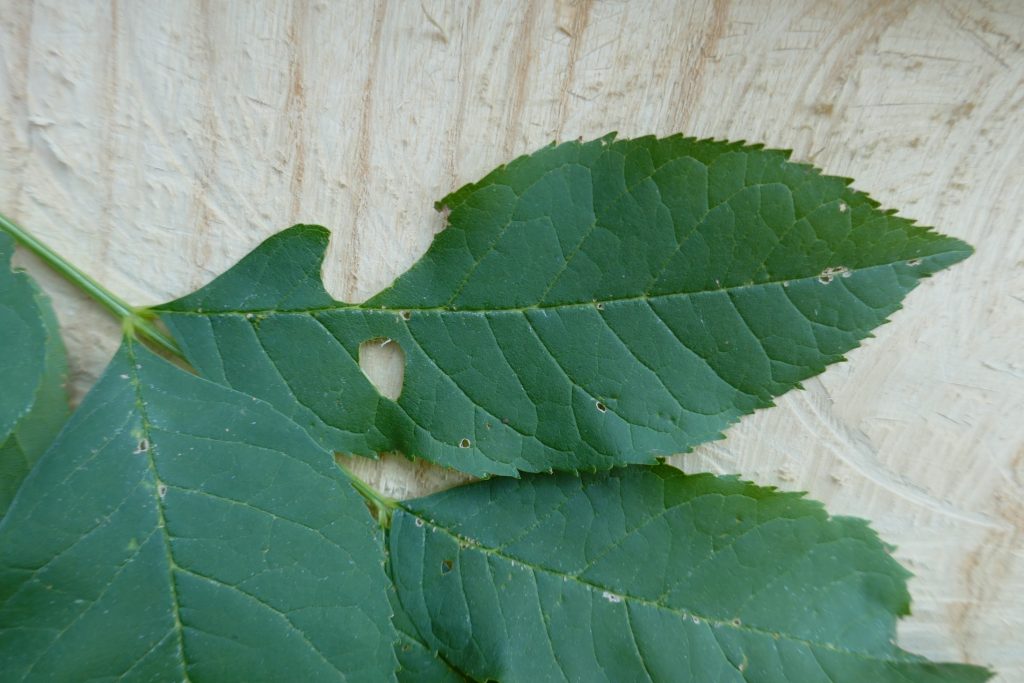
Feeding damage caused by adult beetles can also be fairly characteristic, especially in the crowns, though sometimes lower down as well. They chew notches into leaf margins that may look like the letter G or the shape of a knife can opener. We observed this in Slovakia, but we were not entirely certain. I would therefore treat it as a supplementary symptom.
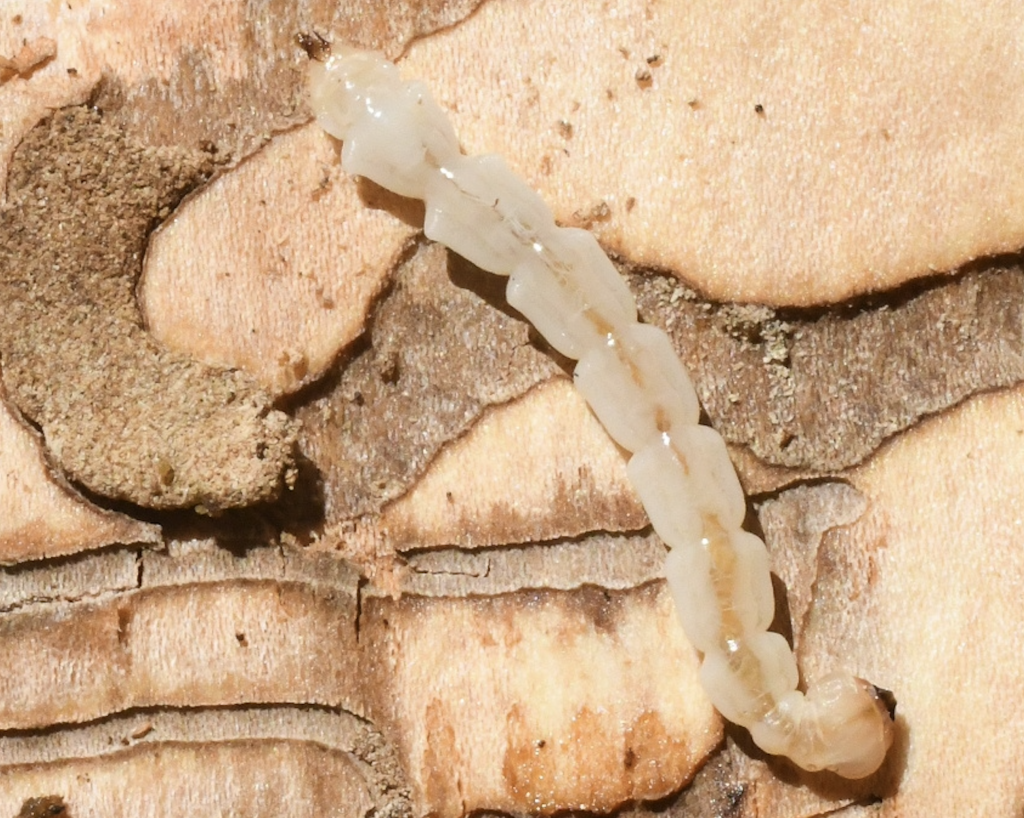
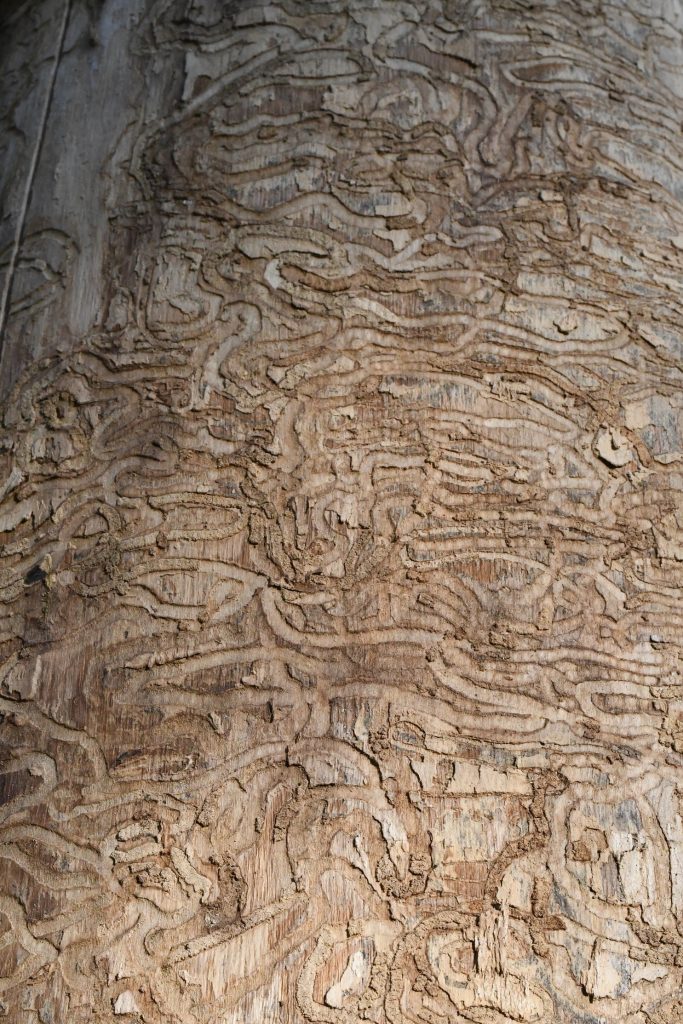
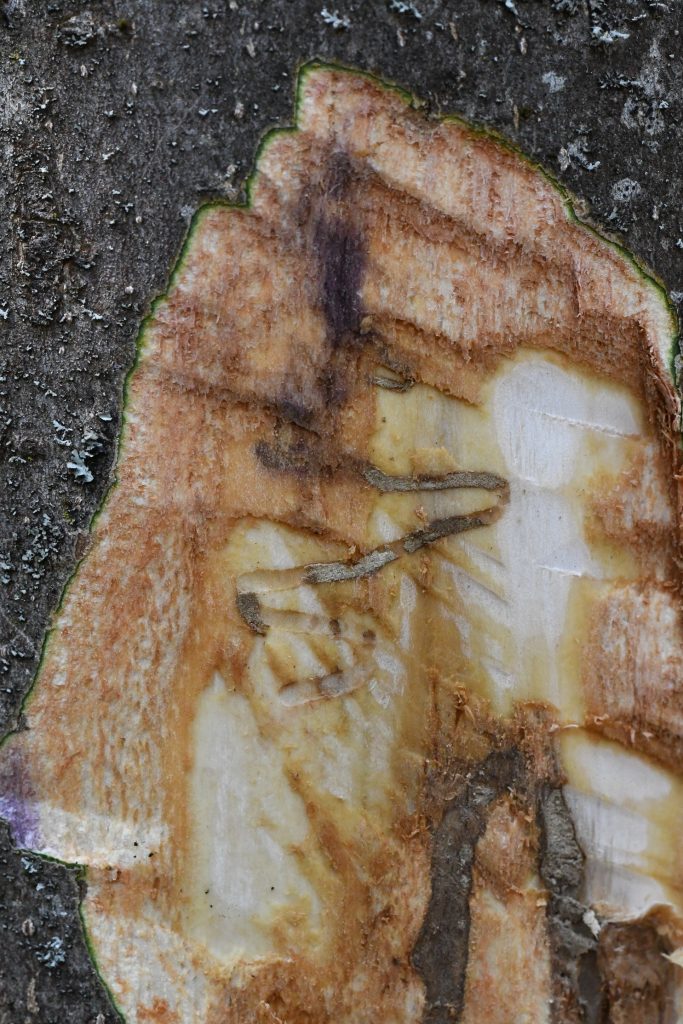
To sum up the main symptoms, what should people focus on first?
I consider woodpecker pecks the best clue. The larval galleries, with their characteristic lying S-shaped tunnels beneath the bark, and the exit holes are also highly distinctive. I see the other signs more as supplementary. But we noticed one more thing in Slovakia.
What was that?
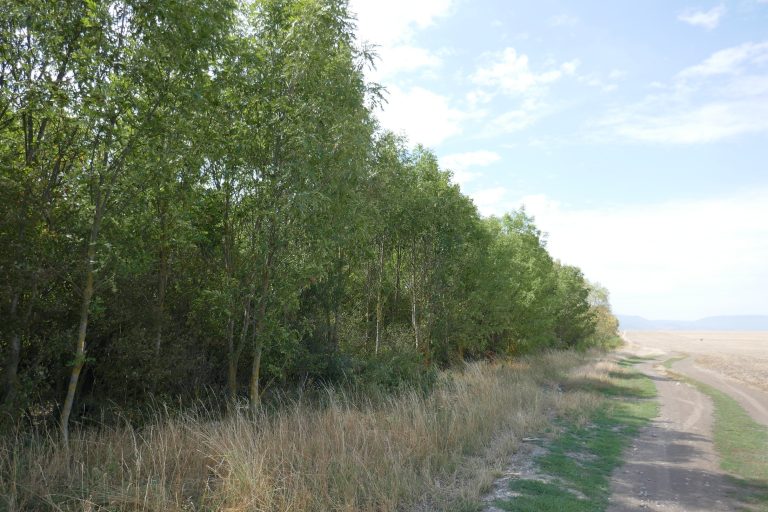
We noticed that there were more finds at the edges of stands. Like other jewel beetles, the emerald ash borer prefers warmer conditions and tends to seek out sun-exposed trees. So I would expect the first detections in parks, avenues and rows of roadside trees, on solitary trees in the landscape, along stand edges or beside rivers. It will probably move deeper into forest stands only once its population has grown.
Now to the most important point: how should we prepare?
First and foremost, we need to change the procedures we have prepared. The plan is to apply the same quarantine regime used for other invasive species. But experience in North America has repeatedly shown that this approach does not work for the emerald ash borer. That is known. We need to respond accordingly and change the plan.
Could you describe the problem in more detail?
The current plan calls for eradication. Yet eradication has repeatedly proved ineffective against the emerald ash borer. Even felling trees within a radius of up to 800 metres did not stop its further spread. The problem is that by the time we detect the beetle, it has usually been present in the landscape for some time and may be farther away than we think. We can hope that, because ash trees here are weakened by ash dieback, the beetle will attack lower parts of the trunk more often and thus be easier to detect. But the essential point is that we should not repeat an approach that has already failed in dozens of US states and several Canadian provinces.
What will they do in Slovakia?
Everything suggests that they will apply that unsuccessful approach.
Why Eradication May Not Work Against the Emerald Ash Borer
In many cases, it is possible to eradicate invading insect populations, especially if they are discovered early. Unfortunately, this is not the case for the emerald ash borer.
In more than 20 instances in the US and Canada, eradication has been attempted by removing infested trees, but this strategy has always failed. The problem is that there is no practical method available for delimiting the extent of newly invaded populations because none of our survey methods can successfully detect low-density emerald ash borer populations.
In virtually all cases, when an invading population of this insect is initially detected, it has already spread quite a long distance and it is impossible to find the spatial extent of the population, thus making it impossible to know where to remove trees.

Andrew Liebhold, Head of the Forest Invasion Synthesis Centre, Prague (FISC).
Will an emerald ash borer invasion have economic consequences?
Major ones. Private owners could be significantly affected too. If an infested ash tree is found on their property, they may be required to fell trees within a 100-metre radius and then dispose of the wood. Just imagine the size of that area! You would need a harvester for that. The costs would be enormous. Yet under the current arrangements, owners would apparently be compensated for only a portion of those costs, roughly 25 to 30 percent. That will be a serious problem for many of them.
Will owners not resist?
What has always happened will happen again. Experience shows that if measures are too expensive or complicated, some owners will not comply. Instead of burning the wood, for example, they may take it away. And transporting infested wood is one of the quickest ways to spread the emerald ash borer to a new location. Paradoxically, eradication measures could therefore have the opposite effect.
How should we proceed to avoid that?
In a situation like the one in Slovakia now, where the beetle is already fairly widespread in part of the country, I think large-scale eradication is unrealistic. It would mainly create enormous problems for owners. We need instead to track the advancing front, locate infestation sites and remove infested trees selectively. We should not fell trees on a massive scale.
And here in Czechia?
The earlier we find the emerald ash borer and remove infested trees, the more we can slow its spread. We will not be able to get rid of it completely; I do not think that is realistic. But the aim is to keep its numbers as low as possible. That is the main strategy.
What do you think the ash population will look like after the emerald ash borer has passed through?
It will probably be mainly the youngest trees that survive, say those up to ten years old, because they are still too small and not attractive enough to the beetle. The problem is that these very young ash trees are also the most susceptible to ash dieback. A lot will depend on the weather too. The ash dieback fungus benefits from moisture at certain stages and dryness at others, while the emerald ash borer benefits from higher temperatures. I am afraid something similar to what happened to elms could happen.
What happened to elms?
Dutch elm disease arrived, and elms virtually disappeared from our landscape. They are now gradually returning, but it has taken 40 to 50 years. I think we could face something similar with ash. Probably only a few percent of the trees will survive. I do not think we can really speak of genetic resistance at this point; that would require targeted breeding followed by planting resistant trees. More likely, we face a period when ash trees will be very scarce, and only in time might their numbers begin to rise again. As with elms.
How do you think the emerald ash borer will spread across Europe?
To the south, I think it will reach Austria through Hungary and may then spread farther south. That is now a very likely route.
The other question is Poland. If the beetle is detected there too, it could spread towards Germany fairly quickly. It has also been found in Belarus, so in theory it could reach Poland from the northeast through the Baltic states as well.
Are there areas of Czechia where the effects will be most severe?
Urban parks are the biggest concern. Ash trees are relatively brittle, and once they die, their branches begin to break. In cities, it will therefore be about more than the trees themselves: there will also be a risk of property damage and a threat to people’s safety. Dead ash trees will have to be removed quickly.
What costs should we expect?
It will be very expensive. In cities, trees will have to be removed using aerial work platforms and specialist arboricultural equipment. Felling a single tree can cost tens of thousands of Czech crowns.
How many ash trees do we have in cities?
A great many. Thousands of trees. Ash was a fairly popular species for a long time: it tolerates drought and difficult urban conditions, such as concrete around its roots, and it also has considerable aesthetic value.
Does that mean we should avoid ash in new plantings?
Definitely. To some extent, that is already happening because of ash dieback. But the biggest problem will be the ash trees we already have in cities. We expect considerable losses there. There are, however, some ways of protecting these trees.
What are they?
One option is trunk injection. A product is injected into the tree, where it remains active for a time and can kill the youngest emerald ash borer larvae. Biologically based products are available here, but synthetic insecticides are not authorised. They are used in North America, however, and can protect a treated tree for two to three years. If we wanted to use them here too, registration would be a problem. The company wishing to market a product has to finance the registration, and the entire process is very costly and time-consuming.
What does that involve?
A whole series of tests is required, above all to assess the product’s environmental impact and efficacy. In practice, it is a process lasting several years, paid for by the applicant seeking registration.
In agriculture, that investment pays off for companies, but in forestry it generally does not. That is why the number of available products is falling: companies are reluctant to undertake costly registration. One advantage is that if the tests have been carried out in one EU member state, other states can accept them. Member states can also grant exemptions in certain cases. And I think it would be worth considering such an option to protect selected valuable urban trees.
And the application itself?
That is costly too, but still cheaper than felling, and it also means the tree could survive. Treatment would have to be carried out by zone, though. If we left one untreated tree among treated trees, the emerald ash borer can concentrate on that one.
Trunk injection can also be used preventively. Biologically based products last about one season, while synthetic ones last roughly two years. So when the emerald ash borer is still scarce at the beginning of an invasion, there may be a chance of suppressing the population locally. I think that is something urban tree managers should consider.
What adverse effects could these synthetic products have?
I do not know the details of this issue. There may, for example, be some risk to the soil, where substances could end up after leaving the tree or falling with its leaves. They will also affect some of the organisms associated with ash.
The advantage of trunk injection is that it is not a spray or mist, so the product does not disperse into the surrounding area and does not come into contact with flowers, for example. Even so, it could affect some insect species and, indirectly, their predators, such as woodpeckers. In theory, there could also be a cumulative effect in the food chain. Compared with some other insecticides, however, the impact would be incomparably smaller. These substances are primarily toxic to insects.
Project HIVE 101187384. Funded by the European Union. Views and opinions expressed are however those of the author(s) only and do not necessarily reflect those of the European Union or the European Research Executive Agency. Neither the European Union nor the granting authority can be held responsible for them.