

Trees are not just passive victims of insect outbreaks. A new study published in Nature Ecology & Evolution shows that they can actively adjust their timing to reduce damage – by delaying the emergence of leaves. The research demonstrates that trees respond to insect herbivory in one year by shifting their phenology in the next.
Spring warming is generally expected to make trees leaf out earlier. However, observations show that this shift has been slower than predicted. The new study helps explain why.
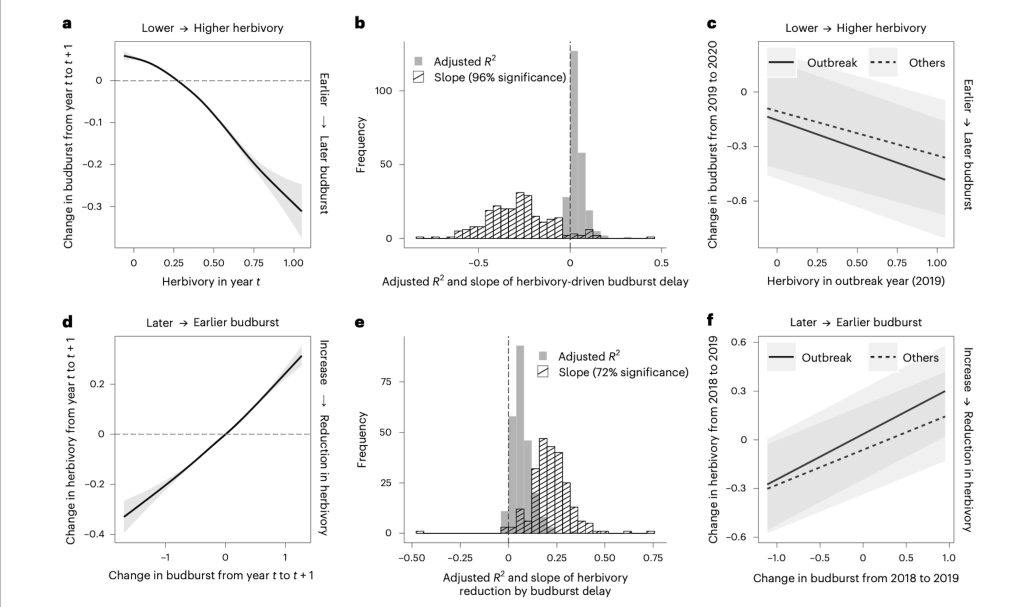
Using five years of satellite data across 60 forest sites in Central Europe, researchers found that trees exposed to higher levels of leaf damage delayed budburst in the following year by around three days. This may seem minor – but it is enough to counteract the effect of a decade of climate warming. The reason lies in timing: many herbivorous insects depend on young leaves emerging at the right moment. By delaying leaf-out, trees effectively “miss” the peak feeding period.
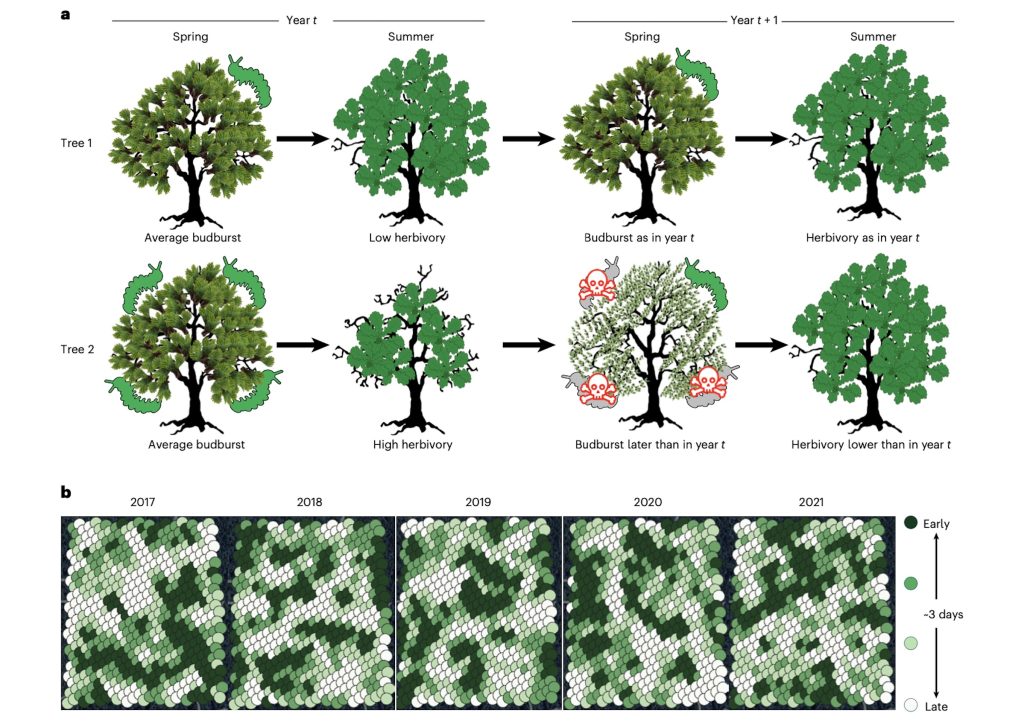
This shift has a strong effect. The study shows that delayed budburst reduces subsequent herbivory by about 55%.
Even more strikingly, this strategy remains effective during large-scale insect outbreaks, when trees are under the greatest pressure.
Rather than being overwhelmed, trees that delay leaf emergence can still significantly reduce damage – challenging the assumption that outbreaks always override plant defence mechanisms.
One of the key advances of the study is its scale. Instead of focusing on individual trees, researchers used high-resolution satellite data to monitor over 27,000 tree crowns across landscapes.
This revealed a dynamic “phenological mosaic”, where different trees adjust their timing differently depending on past herbivory.
Importantly, the delay was strongest in forests where it provided the greatest benefit – suggesting that this is not just a short-term response, but an adaptive strategy shaped by natural selection.
These findings highlight a fundamental tension: trees are responding to two opposing pressures of global change.
This creates a potential “evolutionary trap”, where trees must balance growth opportunities against the risk of damage.
At the same time, this dynamic adjustment may help stabilise forest ecosystems. By redistributing herbivore pressure across space and time, trees can reduce extreme damage and maintain resilience.
The study shows that predicting forest responses to climate change requires more than temperature data alone.
Biotic interactions, such as plant-insect relationships, play a crucial role and can fundamentally alter expected outcomes.
As global change accelerates, understanding these interactions will be key to managing forests and anticipating the spread and impact of invasive species.
Project HIVE 101187384. Funded by the European Union. Views and opinions expressed are however those of the author(s) only and do not necessarily reflect those of the European Union or the European Research Executive Agency. Neither the European Union nor the granting authority can be held responsible for them.