

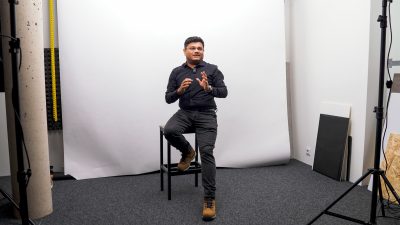
From butterflies and plant–insect interactions to AI-assisted research. In this short video profile, Arka Pal introduces his scientific background and current work at FISC. Below the video, read the accompanying interview, where he discusses how artificial intelligence is changing ecological research, why every AI-generated result still needs careful verification, and what large-scale data can reveal about biological invasions.
Artificial intelligence can analyse thousands of scientific records in a fraction of the time it would take a researcher. But can it really be trusted? Arka Pal explains how AI is transforming invasion ecology, why every result still requires human verification, and what large-scale data reveal about the spread of invasive species.
Your research focuses on interactions between insects and non-native plants. What first drew you to this topic?
I have always been interested in insects, especially butterflies. During my bachelor’s, I worked on a small project studying the oviposition patterns of butterflies on their host plants. The study opened my mind to plant-insect interaction and their ecology. I was fascinated to learn how butterfly species can travel long distances to find their specific host plants and lay eggs on them. Interestingly, different species had distinct host plant preferences, which fascinated me. This led me to pursue a specialisation in entomology during my master’s degree. Thankfully, while searching for a research position in ecology, I came across the FISC’s open doctoral position focused on insect-herbivore associations on non-native plants. I had no doubt that this would be the best opportunity for me to pursue my doctoral research.

What factors influence the richness of both native and non-native insect species associated with non-native plants?
Well, there are quite a few factors influencing the insect herbivore richness (native and non-native) on non-native plants. One of them is the time since the introduction of the non-native plant into the novel habitat, the effect of which on insect species richness I am currently studying in Europe. The other important factor is propagule pressure, that is, the number of introductions and the number of individuals of the non-native plant introduced into the novel habitat. I am planning to study this using comparative timing data on plant and insect invasions in Europe to examine the effect of propagule pressure on the richness of native and non-native insects. Other factors include the phylogenetic relatedness of the non-native plant to the native plants and the abundance of the non-native plant in the novel habitat.
And how does all of this affect native species?
There is a significant negative impact on the native plant species due to the proliferation of non-native plants. Due to a phenomenon called ‘enemy release’, the non-native plants experience a loss of natural enemies that control their population growth in the novel habitat, leading to rapid spread, outcompeting native plants and occupying a larger spatial extent over time. This provides a breeding ground for native and non-native insects, which can grow rapidly with abundant resources and spill over to the native plants, further hindering their growth

Within this broad field, what do you personally find most interesting?
Working on plant-insect associations within a broader spatial context and examining changes at higher resolution is both challenging and fascinating. After reviewing numerous articles across different spatial scales and exploring fundamental ecological questions related to biological invasions, I am genuinely excited about this work. Furthermore, working with Sandy, an eminent scientist in biological invasions, inspires me to contribute more to this field.
What role does AI play in your research?
Artificial Intelligence has made it possible for me to gather large amounts of host plant–insect herbivore association records in a short span of time to conduct the study. I am mostly doing synthesis research, that is, understanding patterns of host-herbivore associations at larger spatial scales using data from primary and secondary sources. AI has helped me consolidate data from various scientific literature sources into a comprehensive dataset to identify patterns. Utilising Large Language Models (LLMs), I have automated the extraction of required resources from sources and their conversion into analysable data.
To what extent can a researcher rely on AI in this kind of work? How do you verify that the data extracted from scientific literature with the help of AI is accurate and suitable for further analysis?
This is one of the most pressing issues in AI-based research right now. One of the ways I verify my work is through provenance: every extracted association data is linked to the source document, including the page number from which it is extracted, along with a snippet of the source text as evidence. The metadata helps me identify the exact source of the information and verify it against the original. To taxonomically standardise the scientific names of plants and insects, I run them through the Global Biodiversity Information Facility (GBIF) Taxonomic Backbone to determine whether the names are truly plant or insect names and are accepted, not synonyms. The best way always lies in manually verifying the data. So I choose a random sample of host-herbivore associations and determine if the error rate is less than 5% of the original data. In this way, I can ensure minimal margin of error in automated data extraction.

What types of sources do you most often draw data from?
My target is to select scientific publications that provide concentrated information on one or multiple host plants and their associated insect herbivores. Therefore, I mostly extract the data I need from databases, data articles and books that list host-herbivore records from field observations or multiple sources.
When working with such a large amount of data, what is the most challenging part: collecting the data, checking their quality, harmonising different formats, or, for example, verifying…?
I did face challenges, sometimes quite annoying, while extracting data from different sources. The biggest problem with performing the automated extraction is that the formats across different sources vary tremendously. For example, a book containing insect herbivores associated with a single plant requires a pattern of extraction without the host plant name (the host plant is the same), whereas an online database with multiple host plant names, each containing different insect species on different pages, requires a separate logical sequence to extract the associations. If a book does not have a good OCR (Optical Character Recognition), then the difficulty increases manifold. I would need to convert it into a text file or use just the scanned images of the book to extract the records. The record extraction was not perfect – I had to perform several iterations before the records were fully extracted as a dataset without errors.
Another challenge we often face is taxonomically harmonising plant and insect names so we can update them to their current accepted names. Since many records come from older literature or sources that used outdated taxonomic names, I have to review each scientific name, match it to the current checklist, and correct it. This becomes more challenging if the insect species is endemic or poorly documented. However challenging the process might be, the final output always gives immense satisfaction.
In the context of biological invasions, are there particular areas where data are still clearly missing?
Surely. There are regional discrepancies in data availability. Data from tropical regions is scarce, especially for plants that are not part of agriculture. Data on novel host plants, insect herbivores, or new associations are seldom presented systematically from large regions of South and South-East Asia, Africa, and Central and South America. This has resulted in biased sampling, with most of the data coming only from particular regions of the world – Europe, North America, Australia, New Zealand and Japan. In many cases, where regular monitoring of non-native species does not occur, the associations are available only from outdated literature. For many species, we still lack the data for the introduction pathways that could help us prevent future introductions.
What concrete impact would you like your research to have?
My study can help explain various invasion ecology hypotheses, many of which appear contradictory, and explain how they function in biological invasions at both continental and global levels. This, in turn, can inform invasion biologists about practical approaches to managing invasive species. At macroecological scales, it can help us understand patterns of plant–insect associations and their coevolution.
FISC, where you are part of the core team, works on the basis of the synthesis centre model. What do you find most valuable about this model?
In short, collaboration and networking. For a budding researcher like me, working at FISC is a great boon, as it allows me to collaborate with eminent scientists and researchers in invasion biology and macroecology. Their innovative ideas and research directions help me learn more about the field and my work. This can go a long way toward helping me pursue my career in plant-insect ecology.

- PhD student at FISC
- focusing on the global synthesis of insect associations on non-native plants
- he's developing AI techniques to compile a database of herbivorous insects associated with non-native plants
Project HIVE 101187384. Funded by the European Union. Views and opinions expressed are however those of the author(s) only and do not necessarily reflect those of the European Union or the European Research Executive Agency. Neither the European Union nor the granting authority can be held responsible for them.