

Skip to content

Dark diversity offers new insight into invasion success

A new study involving FISC postdoctoral researcher Shuya Fan offers a fresh perspective on Darwin’s naturalization conundrum - one of invasion biology’s longest-standing debates. Using historical records of freshwater fish introductions in Swedish lakes, the researchers show that dark diversity can help explain when closely related or distantly related non-native species are more likely to establish.
A new collaborative study involving FISC postdoctoral researcher Shuya Fan, together with Wen-gang Zhang, Dr Meng Xu and colleagues from China, the United Kingdom and Estonia, has been published in the Proceedings of the National Academy of Sciences. The study offers a fresh perspective on one of invasion biology’s longest-standing debates: Darwin’s naturalization conundrum.
Since Darwin, ecologists have debated whether non-native species are more likely to establish when they are closely related to resident native species, because they share similar ecological requirements, or when they are distantly related, because they may avoid strong competition with native relatives.
Although both ideas have received empirical support, studies have often reached contrasting conclusions.
The new study shows that these opposing expectations can be reconciled by considering the dark diversity of resident communities.
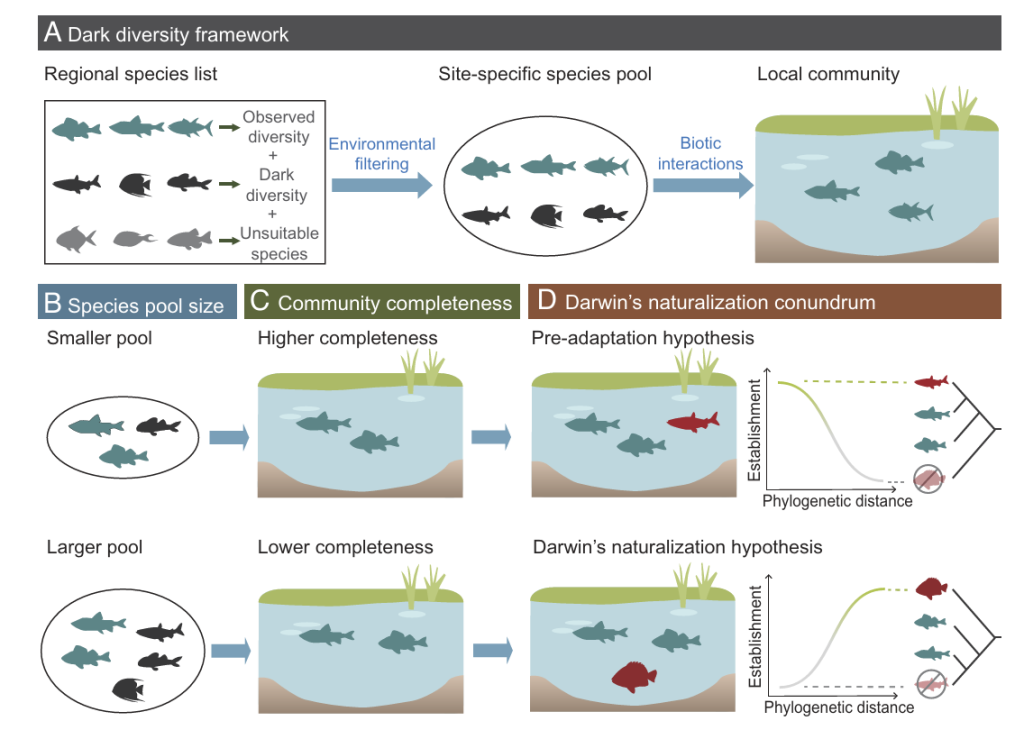
Dark diversity refers to species that could potentially occur at a site under suitable environmental conditions but are currently absent. Together with observed diversity, it defines the site-specific species pool and allows researchers to estimate community completeness, that is, the extent to which the potential species pool is locally realized.
The dark diversity concept as a framework for reconciling Darwin’s naturalization conundrum. (A) Dark diversity (black) refers to species absent from a local community but capable of inhabiting it, together with observed diversity (blue) it defines the site-specific species pool and community completeness (ratio of observed to dark diversity). (B) Smaller species pools, likely reflecting stronger abiotic filtering, would favor the establishment of exotics (red) that are closely related to native species, supporting the preadaptation hypothesis (PAH). In contrast, larger species pools may facilitate the success of distantly related exotics (red), aligning with Darwin’s naturalization hypothesis (DNH). (C) Lower community completeness, characterized by more unfilled niches due to biotic exclusion of native species, favors the establishment of distantly related species, consistent with DNH. Conversely, higher community completeness, indicating fewer unfilled niches and reduced biotic interactions, enhances the success of closely related species, supporting PAH. (D) The PAH predicts exotic species phylogenetically close to native species are more likely to establish, whereas DNH predicts exotic species distantly related to natives are more likely to succeed. https://doi.org/10.1073/pnas.2604929123
Using a 340-year record of freshwater fish introductions across Swedish lakes, the researchers found that the role of phylogenetic relatedness depends on this dark-diversity context.
In communities with smaller species pools and higher community completeness, introduced fish species closely related to resident species were more likely to establish, suggesting that shared ecological requirements may promote invasion success.
In contrast, in communities with larger species pools and lower completeness, phylogenetically distant introduced species were more successful, consistent with the idea that they may occupy less saturated ecological opportunities.
By considering not only the species present in a community, but also those that could potentially occur there, the dark diversity framework helps explain why the effects of phylogenetic relatedness on invasion success differ among recipient communities. This makes invasion forecasts more sensitive to ecological context.
- Shuya Fan

Importantly, the dark diversity framework explained invasion outcomes better than observed species richness alone, highlighting the value of considering not only which species are present, but also which species are ecologically expected yet absent.

The study provides a new conceptual and analytical framework for understanding biological invasions, improving invasion risk assessment and informing ecosystem management.

Downloads

Dark diversity framework reconciles Darwin’s naturalization conundrum for freshwater fish invasions
Download
.pdf, 1.1 MB

Share

Project HIVE 101187384. Funded by the European Union. Views and opinions expressed are however those of the author(s) only and do not necessarily reflect those of the European Union or the European Research Executive Agency. Neither the European Union nor the granting authority can be held responsible for them.