
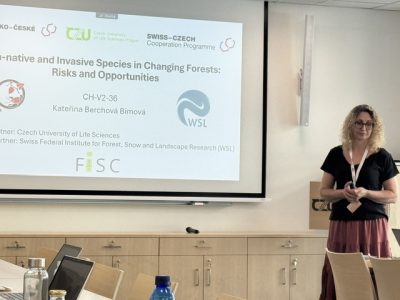
A new Czech–Swiss collaboration has been launched to address non-native and invasive species in changing forest ecosystems. The project Non-native and invasive species in a changing forest: risks and opportunities will focus on non-native tree species increasingly considered in the context of forest adaptation to climate change, as well as non-native pest species, fungal pathogens and other organisms relevant to forest environments.
The project aims to support informed decision-making on the use of non-native species in forestry and to develop management practices that help limit their unwanted spread. Its outputs will be aimed primarily at forestry practitioners, but also at policymakers, educational institutions and the scientific community.
The project covers non-native and invasive species across taxonomic groups, including trees, herbs and shrubs, insects, fungal pathogens and aquatic organisms. One of the key outputs will be a catalogue of model invasive species, including risk assessments of their spread and ecosystem impacts.
The project will also prepare practical guidelines for site selection and silvicultural measures to reduce the risk of invasive spread of non-native tree species. Further outputs will address management and organisational practices for invasive insects and fungal pathogens in forest environments.
The project is led by the Faculty of the Environment, Czech University of Life Sciences Prague. We are pleased that the Forest Invasion Synthesis Centre Prague, hosted by the Faculty of Forestry and Wood Sciences CZU, plays an important role in this collaboration, helping to situate the project within the wider European and global context of non-native species spread. The project also involves the Faculty of Agrobiology, Food and Natural Resources CZU, further strengthening its interdisciplinary scope. The project builds on collaboration with the Swiss Federal Institute for Forest, Snow and Landscape Research (WSL), whose experience with non-native tree cultivation will serve as a model of good practice. Thomas Wohlgemuth, a recognised expert in forest ecology and non-native tree species at WSL, will contribute to the project as a consultant.
Planned outputs include practitioner-oriented articles in Czech forestry outlets, peer-reviewed publications in international scientific journals, workshops for forestry practitioners in cooperation with forestry organisations and secondary forestry schools, and educational materials for forest pedagogy and environmental education.

Project HIVE 101187384. Funded by the European Union. Views and opinions expressed are however those of the author(s) only and do not necessarily reflect those of the European Union or the European Research Executive Agency. Neither the European Union nor the granting authority can be held responsible for them.