

The emerald ash borer (Agrilus planipennis), one of the most destructive invasive pests of ash trees, is moving closer to Central Europe. It was recently detected in Hungary, while its presence is also suspected in Slovakia. The beetle can attack healthy ash trees and kill them within just a few years. This information sheet explains how to recognise the pest and its characteristic damage, and outlines the measures needed to prevent its further spread.
Species description
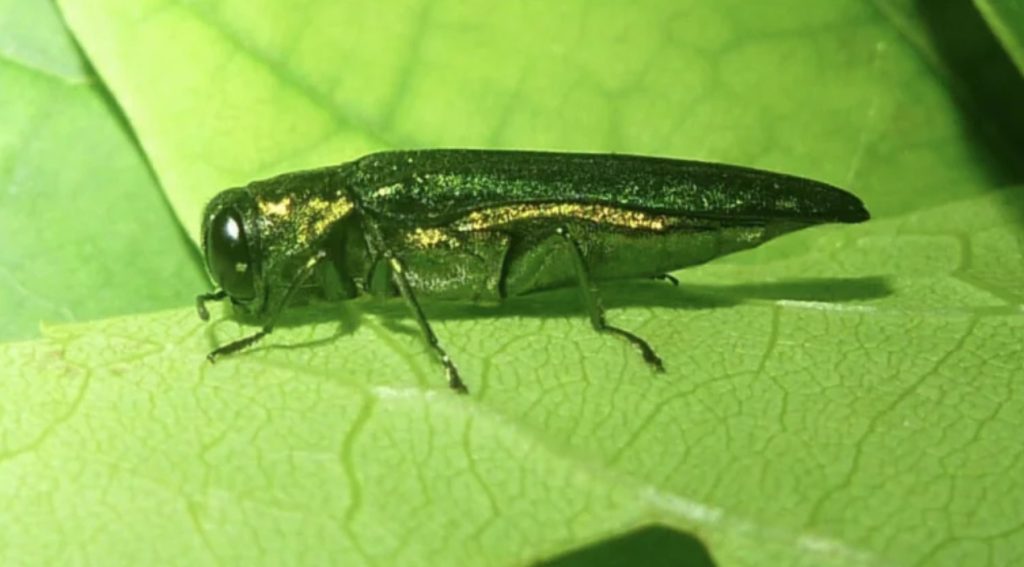
Emerald ash borer (Agrilus planipennis), also known as “EAB”, is a phloem-feeding jewel beetle native to eastern Asia (northeastern China, Japan, Korean Peninsula, Mongolia, Taiwan and the Russian Far East). Adults have a narrow, wedge-shaped body of metallic blue-green colour, 8–14 mm in length, without any spots (though it can be challenging to distinguishes them from similar native species). Larvae are flattened, legless, cream-white, 26–32 mm long, with a distinctly segmented body (CPCR – Plant Health Portal, 2024).
Larvae feed in the phloem of ash trees. Females deposit 68–90 eggs individually into bark crevices; hatching larvae bore into the cambium, where they create serpentine galleries packed with brown frass and sawdust. Adults emerge through a D-shaped exit hole approximately 3–4 mm wide. Development lasts 1–2 years depending on temperature and host vigour; adults are active from mid-May to July. Within its native range the species attacks predominantly weakened trees; outside its native range – where European and North American ash trees lack co-evolved defences, it can colonize vigorous trees and typically kills them within 1–3 years of infestation (Villari et al., 2016; Herms & McCullough, 2014).
Host range
In North America all native ash species are attacked regardless of their vigour (CPCR – Plant Health Portal, 2024; EPPO, 2023). In invasion-affected areas, 95% of all ash trees up to 5 cm stem diameter have died (Sun et al., 2024). Experience from North America indicates that American ash species lack resistance to EAB, and European species appear to react similarly.
Native European species
● Fraxinus excelsior – common ash
● Fraxinus angustifolia – narrow-leaved ash
● Fraxinus ornus – manna ash
Under laboratory conditions, European olive (Olea europaea) has also been recorded as a host (Cipollini et al., 2017).
Cultivated and introduced species
● Fraxinus pennsylvanica – green ash (North American; widely planted in Europe)
● Fraxinus americana – white ash
● Fraxinus nigra – black ash
● Fraxinus quadrangulata – blue ash
The North American fringetree (Chionanthus virginicus) is considered a suboptimal host
Its native Asian hosts are Fraxinus chinensis, F. japonica, F. lanuginosa, F. mandshurica and F. rhynchophylla. These species are attacked but mortality is generally limited to trees under concurrent abiotic stress (Villari et al., 2016).
Current distribution
In North America EAB was first confirmed in 2002 near Detroit, Michigan (USA), presumably introduced with wood packaging from China. It has since spread to more than 35 US states and five Canadian provinces, killing tens of millions of ash trees (Herms & McCullough, 2014; Sun et al., 2024). In Europe the species was first detected in 2003 in Moscow. Since then it has spread in all directions across European Russia; the northernmost populations have been recorded in Yaroslavl and St Petersburg. In 2019 its presence was confirmed in Ukraine and Belarus, close to the EU border. In December 2024 the European Plant Protection Organization (EPPO) organised a webinar attended by experts from 55 countries; Russia, Belarus, Estonia, Finland and Latvia reported on the current status of monitoring (EPPO, 2024).
The species has now also been confirmed from Hungary (June 2026), where it is currently classified as a transient species. A suspected occurrence has also been reported from southeastern Slovakia (July 2026), where confirmation of the species identification by laboratory methods is still pending.
Climate modelling indicates that central European conditions, including those of the Czech Republic, are suitable for EAB establishment (Rossi et al., 2024). EAB has not yet been detected in the Czech Republic – annual official detection surveys have been conducted since 2011. The species is listed as a priority quarantine pest in the EU (Annex II of Commission Implementing Regulation (EU) 2019/2072); in response to the approaching threat, the European Commission adopted specific measures under Regulation (EU) 2024/434, comprising regular phytosanitary inspections and surveys designed to achieve 95% detection confidence at a 1% infestation rate, immediate eradication measures (incineration of host plant biomass), and a public awareness campaign.
Distinguishing EAB damage from ash dieback caused by Hymenoscyphus fraxineus
In Europe ash trees are simultaneously threatened by two invasive harmful organisms of Asian origin – the fungus Hymenoscyphus fraxineus and the emerald ash borer described here. Accurate identification is critical for correct phytosanitary reporting and choice of management response. In the early stages diagnosis is difficult, as both organisms cause similar dieback of the upper crown. The ash dieback fungus (Hymenoscyphus fraxineus, syn. Chalara fraxinea) causes so-called Chalara ash dieback. It manifests as necroses and lesions on twigs and current-year shoots, wilting of foliage from the top down, characteristic olive-brown discolouration of leaf petioles, and – in older trees – basal rot reducing structural stability. Necroses progress top-downwards, with younger trees dying more rapidly (Carroll et al., 2024; Forest Research UK, 2022).
The crowns of EAB-infested trees also die back from the top. The emerald ash borer, however, leaves the following characteristic signs (CPCR – Plant Health Portal, 2024; EPPO, 2023):
● D-shaped adult exit holes in the bark, approximately 3–4 mm wide – key diagnostic feature
● S-shaped larval galleries beneath the bark packed with brown frass and sawdust (visible after removing bark)
● Longitudinal bark splits 5–10 cm long above larval feeding sites in living trees
● Formation of epicormic shoots on the trunk and at the base – a stress response to subcortical feeding
● Increased woodpecker activity – punctate to erosive bark damage where birds probe for larvae
● Progressive crown dieback from the top down, advancing over 1–3 years; feeding begins in the upper trunk and main branches
Confusion between larval galleries and exit holes is unlikely; however, definitive confirmation of EAB presence requires the discovery of larvae after bark removal or the trapping of adults. When both agents co-occur – a situation documented in Ukraine since 2019 – they interact synergistically, causing faster stand decline than either organism alone (Valenta et al., 2022). Any suspicion of EAB presence must be reported immediately to CPCR.
Management options
As EAB has not yet been recorded in central Europe, current management focuses primarily on prevention and preparedness. In countries where the species is established, the following approaches are applied:
● Quarantine measures and regulation of timber movement: Movement of ash timber, branches, bark, wood chips and firewood from infested areas is a key vector of spread. Imports of these commodities from countries where EAB occurs are subject to strict EU phytosanitary requirements (Regulations 2019/2072 and 2024/434). Untreated wood packaging material retaining bark is considered particularly high-risk (CPCR – Plant Health Portal, 2024). Given the current distribution, particular caution is required when importing timber from eastern Europe and Russia.
● Monitoring and early detection: In the Czech Republic, CPCR has conducted annual official detection surveys since 2011, and since 2016 also using traps (green triangular prism sticky traps) baited with a combination of leaf alcohol and manuka oil attracting both sexes, optionally combined with the female-produced sex pheromone attracting males. The monitoring network has been co-funded by the EU since 2015. Unfortunately, these attractants are not very powerful and consequently detection at low densities is not effective. Complementary methods include visual inspection of ash trees and sentinel trees in the form of deliberately weakened individual ash trees.
● Eradication upon detection: Upon confirmed detection, eradication measures must be implemented immediately in accordance with EU law – felling of infested trees and heat treatment or destruction of wood and bark to prevent larval development completing and adults escaping (CPCR – Plant Health Portal, 2024; EPPO PM 9/14). It should be emphasised, however, that in North America all attempts at local eradication have failed. Unfortunately, by the time EAB is detected its population has typically already spread over several kilometres, because reliable detection at low population densities is difficult (Herms & McCullough, 2014; Sun et al., 2024). This does not mean that early detection and immediate eradication should be abandoned – even with a reduced probability of success these measures slow the advance of the invasion.
● Insecticide treatment: For high-value trees in parks and urban green spaces, systemic insecticides – imidacloprid or emamectin benzoate – applied as trunk injection or soil drench may be used to protect individual trees (not as a substitute for eradication). Treatment is effective only preventively or in the early stages of infestation; once more than 40–50% of the crown has died, treatment is generally ineffective. No products are currently approved for this specific use in the EU; research into insecticide treatment methods is ongoing (CPCR – Plant Health Portal, 2024; Smitley et al., 2010; McCullough, 2019).
● Biological control: In North America, parasitoids introduced from Asia have been released since 2007: the egg parasitoid Oobius agrili and the larval parasitoids Tetrastichus planipennisi and Spathius galinae. The combination of T. planipennisi and woodpecker predation reduced larval densities in experimental plots by approximately 76% over five years (Duan et al., 2022). Options for establishing biological control using these parasitoids in Europe prior to EAB arrival are currently being evaluated (Kenis et al., 2024; Gould et al., 2024). A closely related European species, Spathius polonicus (Hymenoptera: Braconidae), which naturally parasitises several native Agrilus species, has also been recorded parasitising EAB larvae in European Russia (30 of 54 collected larvae were parasitised; Orlova-Bienkowskaja & Belokobylskij, 2014). This native European species therefore represents a candidate for augmentative biological control in Europe. Its occurrence across Europe is, however, relatively sparse.
● Genetic resources and stand recovery: In North America a small proportion of surviving ash trees with elevated resistance (so-called ‘lingering ash’) have been identified. Research into their defence mechanisms and breeding of more resistant genotypes represents a long-term perspective for post-invasion stand recovery (Koch et al., 2015).
If emerald ash borer is suspected, contact immediately: Central Institute for Supervising and Testing in Agriculture (CISTA/ÚKZÚZ), tel.: +420 543 548 111, www.ukzuz.cz. This species is a regulated quarantine pest – reporting is a legal obligation.
References cited
Carroll C. et al. (2024): Ash dieback: From Asia to Europe. Plant Pathology 73: 489–506.
Cipollini, D.; Rigsby, C.M.; Peterson, D.L. Feeding and development of emerald ash borer (Coleoptera: Buprestidae) on cultivated olive, Olea europaea. J. Econ. Entomol. 2017, 110, 1935–1937.
Duan J.J. et al. (2022): Significant suppression of invasive emerald ash borer by introduced parasitoids: potential for North American ash recovery. Journal of Pest Science 95: 1081–1090.
EPPO (2022): EPPO Datasheet on Agrilus planipennis [rev. 2021]. Paris.
EPPO (2023): PM 7/154(1) Agrilus planipennis. EPPO Bulletin 53(2): 380–420.
EPPO (2024): Webinar – EAB in the EPPO region: preparedness of countries for further spread. 5 December 2024.
Forest Research UK (2022): Ash dieback (Hymenoscyphus fraxineus). www.forestresearch.gov.uk.
Gould J. et al. (2024): Assessing the feasibility of pre-emptive biological control against EAB in Europe. Biol. Control 197: 105574.
Herms D.A. & McCullough D.G. (2014): Emerald ash borer invasion of North America. Annu. Rev. Entomol. 59: 13–30.
Kenis M. et al. (2024): Parasitoids of Agrilus spp. in Europe: anticipating the arrival of A. planipennis. Biol. Control 198: 105614.
Koch J.L., Carey D.W., Mason M.E., Poland T.M. & Knight K.S. (2015): Intraspecific variation in Fraxinus pennsylvanica responses to emerald ash borer (Agrilus planipennis). New Forests 46: 995–1011.
McCullough D.G. (2019): Challenges, tactics and integrated management of emerald ash borer in North America. Forestry 93(2): 197–211. https://doi.org/10.1093/forestry/cpz049
Orlova-Bienkowskaja M.J. & Belokobylskij S.A. (2014): Discovery of the first European parasitoid of the emerald ash borer Agrilus planipennis. European Journal of Entomology 111(4): 594–596.
Rossi J.-P. et al. (2024): Modelling the potential range of Agrilus planipennis in Europe. Trees, Forests and People 16: 100559.
Smitley D.R., Doccola J.J. & Cox D.L. (2010): Multiple-year protection of ash trees from emerald ash borer with a single trunk injection of emamectin benzoate, and single-year protection with an imidacloprid basal drench. Arboric. Urban For. 36: 117–124.
Sun J. et al. (2024): Emerald ash borer management and research: decades of damage and still expanding. Annu. Rev. Entomol. 69: 239–258.
CPCR – Czech Plant Health Portal MoA (2024): Emerald ash borer (Agrilus planipennis). https://mze.gov.cz/fytoportal [accessed 2025].
Valenta V. et al. (2022): Invasion of EAB and ash dieback pathogen Hymenoscyphus fraxineus in Ukraine. Forests 13: 789.
Villari C. et al. (2016): Progress and gaps in understanding mechanisms of ash tree resistance to EAB. New Phytologist 209: 63–79.
Project HIVE 101187384. Funded by the European Union. Views and opinions expressed are however those of the author(s) only and do not necessarily reflect those of the European Union or the European Research Executive Agency. Neither the European Union nor the granting authority can be held responsible for them.